
Anti-PUS7L Antibody Picoband®
Primary Antibody supplied by Boster Bio Read more ›

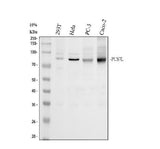
Product Description
Pseudouridylate synthase 7 homolog-like protein is an enzyme that in humans is encoded by the PUS7L gene. PUS7L (pseudouridylate synthase 7 homolog (S. cerevisiae) -like) is a 701 amino acid protein that belongs to the pseudouridine synthase truD family and contains one TRUD domain. The PUS7L gene is conserved in chimpanzee, canine, bovine, mouse, chicken and zebrafish, and maps to human chromosome 12q12. Encoding over 1,100 genes within 132 million bases, chromosome 12 makes up about 4.5% of the human genome. A number of skeletal deformities are linked to chromosome 12 including hypochondrogenesis, achondrogenesis and Kniest dysplasia. Noonan syndrome, which includes heart and facial developmental defects among the primary symptoms, is caused by a mutant form of PTPN11 gene product, SH-PTP2. Chromosome 12 is also home to a homeobox gene cluster which encodes crucial transcription factors for morphogenesis, and the natural killer complex gene cluster encoding C-type lectin proteins which mediate the NK cell response to MHC I interaction.
Product information
| Supplier | Boster Bio |
|---|---|
| ABMIUM evidence status | ABMIUM Verified™ collaborator-tested data |
| Catalogue reference | A14523-1 |
| Product category | Primary Antibodies |
| Reactive species | Human, Mouse, Rat |
| Tested applications | ELISA, Flow Cytometry, IF/ICC, IHC, IHC-P, IP, WB |
| Available conjugations | Unconjugated, Biotin, Cy3, Fluoro488, Fluoro550, Fluoro594, FITC, HRP, APC, PE, Fluoro647 |
| Gene name | PUS7L |
| Protein name | Pseudouridylate synthase PUS7L |
| Immunogen | E.coli-derived human PUS7L recombinant protein (Position: R165-H699). |
| Host | Rabbit |
| Clonality | Polyclonal |
| Isotype | Rabbit IgG |
| Purification | Immunogen affinity purified. |
| Storage | At -20℃ for one year from date of receipt. After reconstitution, at 4℃ for one month. It can also be aliquotted and stored frozen at -20℃ for six months. Avoid repeated freezing and thawing. |
| UniProt | Q9H0K6 |
| NCBI Gene ID | 83448 |
Available variants
| Conjugation | Size |
|---|---|
| Unconjugated | 100 μg/vial |
| Biotin | 100 μg/vial |
| Cy3 | 100 μg/vial |
| Fluoro488 | 100 μg/vial |
| Fluoro550 | 100 μg/vial |
| Fluoro594 | 100 μg/vial |
| FITC | 100 μg/vial |
| HRP | 100 μg/vial |
| APC | 100 μg/vial |
| PE | 100 μg/vial |
| Fluoro647 | 100 μg/vial |
Key Facts
| Target | Pseudouridylate synthase PUS7L |
| Also known as | PUS7L; Pseudouridylate synthase 7 homolog-like protein |
| Concentration | Adding 0.2 ml of distilled water will yield a concentration of 500 μg/ml. |
| Species reactivity | Human,Mouse,Rat |
| Observed band | 81 kDa |
| Form / buffer | Lyophilized |
| Shelf life | At -20℃ for one year from date of receipt. After reconstitution, at 4℃ for one month. It can also be aliquotted and stored frozen at -20℃ for six months. Avoid repeated freezing and thawing. |
| Host species | Rabbit |
| Clonality | Polyclonal |
| Isotype | Rabbit IgG |
| Conjugation | Unconjugated|Biotin|Cy3|Fluoro488|Fluoro550|Fluoro594|FITC|HRP|APC|PE|Fluoro647 |
| Non-cross-reactive with | No cross-reactivity with other proteins |
| Tested applications |
ELISAFlow CytometryIF/ICCIHCIHC-PIPWB |
| Dilution range | Western blot, 0.25-0.5 μg/ml, Human Immunohistochemistry(Paraffin-embedded Section), 2-5 μg/ml, Mouse, Rat Immunofluorescence, 5 μg/ml, Mouse, Rat Immunoprecipitation, 0.5-2 μg/ml, Human ELISA, 0.1-0.5 μg/ml, - |
| Immunogen | E.coli-derived human PUS7L recombinant protein (Position: R165-H699). |
| Purification | Immunogen affinity purified. |
Reactivity & Application Validation
3 speciess| Species | WB | IHC | IHC-P | IHC-F | IF/ICC | FLOW CYTOMETRY | ELISA | IP |
|---|---|---|---|---|---|---|---|---|
| Human | ||||||||
| Mouse | ||||||||
| Rat |
Specifications
Immunohistochemistry(Paraffin-embedded Section), 2-5 μg/ml, Mouse, Rat
Immunofluorescence, 5 μg/ml, Mouse, Rat
Immunoprecipitation, 0.5-2 μg/ml, Human
ELISA, 0.1-0.5 μg/ml, -
Storage & Stability
Compliance & Certifications
Not intended for diagnostic or therapeutic use.