
Primary Antibody supplied by Boster Bio Read more ›

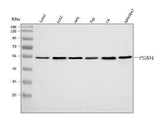
Anti-PSMD4 Antibody Picoband® is a research-use antibody from Boster Bio for studying 26S proteasome non-ATPase regulatory subunit 4 in ELISA, Flow Cytometry, IF/ICC, IHC, IHC-P, IP, WB workflows with listed reactivity for Human, Mouse, Rat. Specifications and supporting documents below should be reviewed when planning the experiment.
Boster Bio Anti-PSMD4 Antibody Picoband® catalog # A03544-1. Tested in ELISA, Flow Cytometry, IP, IF, IHC, ICC, WB applications. This antibody reacts with Human, Mouse, Rat. The brand Picoband indicates this is a premium antibody that guarantees superior quality, high affinity, and strong signals with minimal background in Western blot applications. Only our best-performing antibodies are designated as Picoband, ensuring unmatched performance.26S proteasome non-ATPase regulatory subunit 4, also as known as 26S Proteasome Regulatory Subunit Rpn10 (systematic nomenclature), is an enzyme that in humans is encoded by the PSMD4 gene. The 26S proteasome is a multicatalytic proteinase complex with a highly ordered structure composed of 2 complexes, a 20S core and a 19S regulator. The 20S core is composed of 4 rings of 28 non-identical subunits; 2 rings are composed of 7 alpha subunits and 2 rings are composed of 7 beta subunits. The 19S regulator is composed of a base, which contains 6 ATPase subunits and 2 non-ATPase subunits, and a lid, which contains up to 10 non-ATPase subunits. Proteasomes are distributed throughout eukaryotic cells at a high concentration and cleave peptides in an ATP/ubiquitin-dependent process in a non-lysosomal pathway. An essential function of a modified proteasome, the immunoproteasome, is the processing of class I MHC peptides. This gene encodes one of the non-ATPase subunits of the 19S regulator lid. Pseudogenes have been identified on chromosomes 10 and 21.
| Collaborator | Boster Bio |
| Partner model | A03544-1 |
| Target | 26S proteasome non-ATPase regulatory subunit 4 |
| Reactivity | Human,Mouse,Rat |
| Applications | ELISA,Flow Cytometry,IF/ICC,IHC,IHC-P,IP,WB |
| Conjugation | Unconjugated|Biotin|Cy3|Fluoro488|Fluoro550|Fluoro594|FITC|HRP|APC|PE|Fluoro647 |
| Cross-reactivity | No cross-reactivity with other proteins. |
| Dilution range | Western blot, 0.1-0.25 μg/ml, Human, Mouse, Rat<br> Immunohistochemistry(Paraffin-embedded Section), 2-5 μg/ml, Human, Mouse, Rat<br> Immunocytochemistry/Immunofluorescence, 5 μg/ml, Human<br> Immunofluorescence, 5 μg/ml, Human, Rat<br> Immunoprecipitation, 0.5-2 μg/ml, Human<br> Flow Cytometry (Fixed), 1-3 μg/1x10<sup>6</sup> cells, Human<br> ELISA, 0.1-0.5 μg/ml, -<br> |
| Host | Rabbit |
| Clonality | Polyclonal |
| Isotype | Rabbit IgG |
| Immunogen | E.coli-derived human PSMD4 recombinant protein (Position: M1-E322). |
| Concentration | Adding 0.2 ml of distilled water will yield a concentration of 500 μg/ml. |
| Purification | Immunogen affinity purified. |
| Shelf life | At -20℃ for one year from date of receipt. After reconstitution, at 4℃ for one month. It can also be aliquotted and stored frozen at -20℃ for six months. Avoid repeated freezing and thawing. |
| Availability | Available |
| Species | WB | IHC | IHC-P | IHC-F | IF/ICC | Flow Cytometry | ELISA | IP |
|---|---|---|---|---|---|---|---|---|
| Human | ||||||||
| Mouse | ||||||||
| Rat |
Collaborator meets ABMIUM quality standards and overall product performance standards have been met.
For research applications. Not for diagnostic use.
No customer reviews yet.
