
Primary Antibody supplied by Boster Bio Read more ›

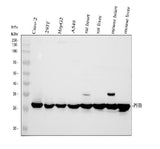
Anti-Prohibitin/PHB Antibody Picoband® is a research-use antibody from Boster Bio for studying Prohibitin 1 in ELISA, Flow Cytometry, IF/ICC, IHC, IHC-P, WB workflows with listed reactivity for Human, Mouse, Rat. Specifications and supporting documents below should be reviewed when planning the experiment.
Boster Bio Anti-Prohibitin/PHB Antibody Picoband® catalog # A01178-1. Tested in ELISA, IF, IHC, ICC, WB applications. This antibody reacts with Human, Mouse, Rat. The brand Picoband indicates this is a premium antibody that guarantees superior quality, high affinity, and strong signals with minimal background in Western blot applications. Only our best-performing antibodies are designated as Picoband, ensuring unmatched performance.PHB (Prohibitin), also known as PHB1, is a protein that in humans is encoded by the PHB gene. White et al. (1991) mapped the PHB gene to chromosome 17 by analysis of human-mouse somatic cell hybrid cell lines using a genomic fragment of human prohibitin DNA isolated from a library using the rat prohibitin cDNA clone. By in situ hybridization, they localized the gene to 17q21. Sato et al. (1992) isolated the human homolog of the rat prohibitin gene and mapped it to 17q12-q21 by in situ hybridization. Proliferation of tumor cells depends on new blood vessel formation (angiogenesis) that accompanies malignant progression. Anticancer therapies using angiogenesis inhibitors or cytotoxic agents targeted to the vasculature of tumors have been evaluated in clinical trials. Although white fat is a nonmalignant tissue, it has the capability to quickly proliferate and expand. Furthermore, it is highly vascularized. Rupnick et al. (2002) showed that nonspecific angiogenesis inhibitors can prevent the development of obesity of mice.
| Collaborator | Boster Bio |
| Partner model | A01178-1 |
| Target | Prohibitin 1 |
| Reactivity | Human,Mouse,Rat |
| Applications | ELISA,Flow Cytometry,IF/ICC,IHC,IHC-P,WB |
| Conjugation | Unconjugated|Biotin|Cy3|Fluoro488|Fluoro550|Fluoro594|FITC|HRP|APC|PE|Fluoro647 |
| Cross-reactivity | No cross-reactivity with other proteins. |
| Dilution range | Western blot, 0.25-0.5μg/ml, Human, Mouse, Rat<br> Immunohistochemistry (Paraffin-embedded Section), 2-5μg/ml, Human<br> Immunocytochemistry/Immunofluorescence, 5 μg/ml, Human<br> ELISA, 0.1-0.5μg/ml, -<br> |
| Host | Rabbit |
| Clonality | Polyclonal |
| Isotype | Rabbit IgG |
| Immunogen | E.coli-derived human Prohibitin/PHB recombinant protein (Position: M1-I257). |
| Concentration | Adding 0.2 ml of distilled water will yield a concentration of 500 μg/ml. |
| Purification | Immunogen affinity purified. |
| Shelf life | Store at -20℃ for one year from date of receipt. After reconstitution, at 4℃ for one month. It can also be aliquotted and stored frozen at -20℃ for six months. Avoid repeated freeze-thaw cycles. |
| Availability | Available |
| Species | WB | IHC | IHC-P | IHC-F | IF/ICC | Flow Cytometry | ELISA | IP |
|---|---|---|---|---|---|---|---|---|
| Human | ||||||||
| Mouse | ||||||||
| Rat |
Collaborator meets ABMIUM quality standards and overall product performance standards have been met.
For research applications. Not for diagnostic use.
No customer reviews yet.
