
Primary Antibody supplied by Boster Bio Read more ›

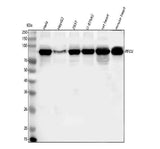
Anti-PFKM Antibody Picoband® is a research-use antibody from Boster Bio for studying ATP-dependent 6-phosphofructokinase, muscle type in ELISA, Flow Cytometry, IF/ICC, IHC, IHC-P, WB workflows with listed reactivity for Human, Mouse, Rat. Specifications and supporting documents below should be reviewed when planning the experiment.
Boster Bio Anti-PFKM Antibody Picoband® catalog # A13973-1. Tested in WB, IHC, ICC/IF, Flow Cytometry, ELISA applications. This antibody reacts with Human, Mouse, Rat. The brand Picoband indicates this is a premium antibody that guarantees superior quality, high affinity, and strong signals with minimal background in Western blot applications. Only our best-performing antibodies are designated as Picoband, ensuring unmatched performance.6-phosphofructokinase, muscle type is an enzyme that in humans is encoded by the PFKM gene on chromosome 12. Three phosphofructokinase isozymes exist in humans: muscle, liver and platelet. These isozymes function as subunits of the mammalian tetramer phosphofructokinase, which catalyzes the phosphorylation of fructose-6-phosphate to fructose-1,6-bisphosphate. Tetramer composition varies depending on tissue type. This gene encodes the muscle-type isozyme. Mutations in this gene have been associated with glycogen storage disease type VII, also known as Tarui disease. Alternatively spliced transcript variants have been described.
| Collaborator | Boster Bio |
| Partner model | A00437-2 |
| Target | ATP-dependent 6-phosphofructokinase, muscle type |
| Reactivity | Human,Mouse,Rat |
| Applications | ELISA,Flow Cytometry,IF/ICC,IHC,IHC-P,WB |
| Conjugation | Unconjugated|Biotin|Cy3|Fluoro488|Fluoro550|Fluoro594|FITC|HRP|APC|PE|Fluoro647 |
| Cross-reactivity | No cross reactivity with other proteins. |
| Dilution range | Western blot, 0.25-0.5 μg/ml, Human, Mouse, Rat<br> Immunohistochemistry (Paraffin-embedded Section), 2-5 μg/ml, Human, Mouse, Rat<br> Immunocytochemistry/Immunofluorescence, 5 μg/ml, Human<br> Flow Cytometry (Fixed), 1-3 μg/1x10<sup>6</sup> cells, Human<br> ELISA, 0.1-0.5 μg/ml, -<br> |
| Host | Rabbit |
| Clonality | Polyclonal |
| Isotype | IgG |
| Immunogen | E.coli-derived human PFKM recombinant protein (Position: R39-V780). Human PFKM shares 97.7% and 96.8% amino acid (aa) sequence identity with mouse and rat PFKM, respectively. |
| Concentration | Adding 0.2 ml of distilled water will yield a concentration of 500 μg/ml. |
| Purification | Immunogen affinity purified. |
| Shelf life | At -20℃ for one year from date of receipt. After reconstitution, at 4℃ for one month. It can also be aliquotted and stored frozen at -20℃ for six months. Avoid repeated freezing and thawing. |
| Availability | Available |
| Species | WB | IHC | IHC-P | IHC-F | IF/ICC | Flow Cytometry | ELISA | IP |
|---|---|---|---|---|---|---|---|---|
| Human | ||||||||
| Mouse | ||||||||
| Rat |
Collaborator meets ABMIUM quality standards and overall product performance standards have been met.
For research applications. Not for diagnostic use.
No customer reviews yet.
