
Primary Antibody supplied by Boster Bio Read more ›

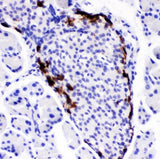
Anti-Peptide YY/PYY Antibody is a research-use antibody from Boster Bio for studying Peptide YY in ELISA, Flow Cytometry, IF/ICC, IHC, IHC-P, WB workflows with listed reactivity for Mouse, Rat. Specifications and supporting documents below should be reviewed when planning the experiment.
Boster Bio Anti-Peptide YY/PYY Antibody Picoband® catalog # PB10014. Tested in IF, IHC applications. This antibody reacts with Mouse, Rat.Peptide YY (PYY), also known as peptide tyrosine tyrosine, is a peptide that in humans is encoded by the PYY gene. This gene encodes a member of the neuropeptide Y (NPY) family of peptides. The encoded preproprotein is proteolytically processed to generate two alternative peptide products that differ in length by three amino acids. These peptides, secreted by endocrine cells in the gut, exhibit different binding affinities for each of the neuropeptide Y receptors. Binding of the encoded peptides to these receptors mediates regulation of pancreatic secretion, gut mobility and energy homeostasis. Rare variations in this gene could increase susceptibility to obesity and elevated serum levels of the encoded peptides may be associated with anorexia nervosa. Ready to elevate your research? Embrace the freedom to customize your peptides based on sequence, purity, and modifications. We're here to support your scientific endeavors with our top-notch custom peptide synthesis service.
| Collaborator | Boster Bio |
| Partner model | PB10014 |
| Target | Peptide YY |
| Reactivity | Mouse,Rat |
| Applications | ELISA,Flow Cytometry,IF/ICC,IHC,IHC-P,WB |
| Conjugation | Unconjugated|Biotin|Cy3|Fluoro488|Fluoro550|Fluoro594|FITC|HRP|APC|PE|Fluoro647 |
| Cross-reactivity | No cross-reactivity with other proteins |
| Dilution range | Immunohistochemistry (Paraffin-embedded Section), 0.5-1μg/ml, Mouse, Rat<br> Immunofluorescence, 5 μg/ml, Rat<br> |
| Host | Rabbit |
| Clonality | Polyclonal |
| Isotype | Rabbit IgG |
| Immunogen | A synthetic peptide corresponding to a sequence in the middle region of mouse Peptide YY, different from the related human sequence by three amino acids, and identical to the related rat sequence. |
| Concentration | Adding 0.2 ml of distilled water will yield a concentration of 500 μg/ml. |
| Purification | Immunogen affinity purified. |
| Purity | No cross reactivity with other proteins. |
| Shelf life | Store at -20℃ for one year from date of receipt. After reconstitution, at 4℃ for one month. It can also be aliquotted and stored frozen at -20℃ for six months. Avoid repeated freeze-thaw cycles. |
| Availability | Available |
| Species | WB | IHC | IHC-P | IHC-F | IF/ICC | Flow Cytometry | ELISA | IP |
|---|---|---|---|---|---|---|---|---|
| Mouse | ||||||||
| Rat |
Collaborator meets ABMIUM quality standards and overall product performance standards have been met.
For research applications. Not for diagnostic use.
No customer reviews yet.
