Primary Antibody ABMIUM Verified™Collaborator Tested
ABM-21485

Anti-Mast Cell Tryptase/TPSAB1 Antibody Picoband®

ABMIUM Verified™|Collaborator Tested|Boster Bio

Primary Antibody supplied by Boster Bio Read more ›

Related formats
Anti-Mast Cell Tryptase/TPSAB1 Antibody Picoband® Boster Bio
Zoom
Anti-Mast Cell Tryptase/TPSAB1 Antibody Picoband® Boster Bio

Product Description

Boster Bio Anti-Mast Cell Tryptase/TPSAB1 Antibody Picoband® catalog # PB10016. Tested in ELISA, IHC, WB applications. This antibody reacts with Human. The brand Picoband indicates this is a premium antibody that guarantees superior quality, high affinity, and strong signals with minimal background in Western blot applications. Only our best-performing antibodies are designated as Picoband, ensuring unmatched performance.

Tryptase alpha-1 and tryptase beta-1 are enzymes that in humans are encoded by the same TPSAB1 gene. Tryptases comprise a family of trypsin-like serine proteases, the peptidase family S1. Tryptases are enzymatically active only as heparin-stabilized tetramers, and they are resistant to all known endogenous proteinase inhibitors. Several tryptase genes are clustered on chromosome 16p13.3. These genes are characterized by several distinct features. They have a highly conserved 3' UTR and contain tandem repeat sequences at the 5' flank and 3' UTR which are thought to play a role in regulation of the mRNA stability. In addition, these genes have an intron immediately upstream of the initiator Met codon, which separates the site of transcription initiation from protein coding sequence. This feature is characteristic of tryptases but is unusual in other genes. The alleles of this gene exhibit an unusual amount of sequence variation, such that the alleles were once thought to represent two separate genes, alpha and beta 1. Beta tryptases appear to be the main isoenzymes expressed in mast cells; whereas in basophils, alpha tryptases predominate. Tryptases have been implicated as mediators in the pathogenesis of asthma and other allergic and inflammatory disorders.

Product information

Supplier Boster Bio
ABMIUM evidence status ABMIUM Verified™ collaborator-tested data
Catalogue reference PB10016
Product category Primary Antibodies
Reactive species Human
Tested applications ELISA, Flow Cytometry, IHC, IHC-P, WB
Available conjugations Unconjugated, Biotin, Cy3, Fluoro488, Fluoro550, Fluoro594, FITC, HRP, APC, PE, Fluoro647
Gene name TPSAB1
Protein name Tryptase alpha/beta-1
Specificity No cross reactivity with other proteins.
Immunogen E. coli-derived human Mast Cell Tryptase recombinant protein (Position: H65-P275). Human Mast Cell Tryptase shares 77% and 76.1% amino acid (aa) sequence identity with mouse and rat Mast Cell Tryptase, respectively.
Host Rabbit
Clonality Polyclonal
Isotype Rabbit IgG
Purification Immunogen affinity purified.
Storage Store at -20℃ for one year from date of receipt. After reconstitution, at 4℃ for one month. It can also be aliquotted and stored frozen at -20℃ for six months. Avoid repeated freeze-thaw cycles.
UniProt Q15661
NCBI Gene ID 7177

Available variants

Conjugation Size
Unconjugated 100 μg/vial
Biotin 100 μg/vial
Cy3 100 μg/vial
Fluoro488 100 μg/vial
Fluoro550 100 μg/vial
Fluoro594 100 μg/vial
FITC 100 μg/vial
HRP 100 μg/vial
APC 100 μg/vial
PE 100 μg/vial
Fluoro647 100 μg/vial

Key Facts

Product type Primary Antibody Target: Tryptase alpha/beta-1
Target Tryptase alpha/beta-1
Also known as MCP7; TPS1; TPS2; TPSAB1; TPSB1; Tryptase 1; tryptase alpha/beta 1; Tryptase beta 1; Tryptase I
Concentration Adding 0.2 ml of distilled water will yield a concentration of 500 μg/ml.
Species reactivity Human
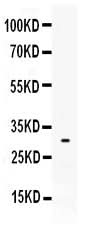
Observed band 30 kDa
Purity No cross reactivity with other proteins.
Form / buffer Lyophilized
Shelf life Store at -20℃ for one year from date of receipt. After reconstitution, at 4℃ for one month. It can also be aliquotted and stored frozen at -20℃ for six months. Avoid repeated freeze-thaw cycles.
Host species Rabbit
Clonality Polyclonal
Isotype Rabbit IgG
Conjugation Unconjugated|Biotin|Cy3|Fluoro488|Fluoro550|Fluoro594|FITC|HRP|APC|PE|Fluoro647
Non-cross-reactive with No cross-reactivity with other proteins
Tested applications
ELISAFlow CytometryIHCIHC-PWB
Dilution range Western blot, 0.1-0.5μg/ml, Human
Immunohistochemistry (Paraffin-embedded Section), 0.5-1μg/ml, Human
ELISA(Cap) , 1-5μg/ml, Human, -
Immunogen E. coli-derived human Mast Cell Tryptase recombinant protein (Position: H65-P275). Human Mast Cell Tryptase shares 77% and 76.1% amino acid (aa) sequence identity with mouse and rat Mast Cell Tryptase, respectively.
Purification Immunogen affinity purified.
Why researchers trust ABMIUM
2,000+ Researchers trust us
50,000+ Citations
ISO 9001 Certified Collaborators

Reactivity & Application Validation

1 species
ABMIUM Validated™ ABMIUM Verified™ Expected Performance Not suitable
SpeciesWBIHCIHC-PIHC-FIF/ICCFLOW CYTOMETRYELISAIP
Human

Specifications

Target
Tryptase alpha/beta-1
Also known as
MCP7; TPS1; TPS2; TPSAB1; TPSB1; Tryptase 1; tryptase alpha/beta 1; Tryptase beta 1; Tryptase I
Concentration
Adding 0.2 ml of distilled water will yield a concentration of 500 μg/ml.
Purity
No cross reactivity with other proteins.
Form / buffer
Lyophilized
Host species
Rabbit
Clonality
Polyclonal
Isotype
Rabbit IgG
Conjugation
Unconjugated|Biotin|Cy3|Fluoro488|Fluoro550|Fluoro594|FITC|HRP|APC|PE|Fluoro647
Species reactivity
Human
Tested applications
ELISAFlow CytometryIHCIHC-PWB
Immunogen
E. coli-derived human Mast Cell Tryptase recombinant protein (Position: H65-P275). Human Mast Cell Tryptase shares 77% and 76.1% amino acid (aa) sequence identity with mouse and rat Mast Cell Tryptase, respectively.
Observed band
30 kDa
Dilution range
Western blot, 0.1-0.5μg/ml, Human
Immunohistochemistry (Paraffin-embedded Section), 0.5-1μg/ml, Human
ELISA(Cap) , 1-5μg/ml, Human, -
Purification
Immunogen affinity purified.

Storage & Stability

Add 0.2ml of distilled water will yield a concentration of 500ug/ml.
Shipped at
Ambient or cold-chain dependent on product format
Short-term storage
Store at -20℃ for one year from date of receipt. After reconstitution, at 4℃ for one month. It can also be aliquotted and stored frozen at -20℃ for six months. Avoid repeated freeze-thaw cycles.
Long-term storage
Store at -20℃ for one year from date of receipt. After reconstitution, at 4℃ for one month. It can also be aliquotted and stored frozen at -20℃ for six months. Avoid repeated freeze-thaw cycles.
Storage conditions
Store at -20℃ for one year from date of receipt. After reconstitution, at 4℃ for one month. It can also be aliquotted and stored frozen at -20℃ for six months. Avoid repeated freeze-thaw cycles.
Storage buffer
Each vial contains antibody formulated with stabilizing components, 0.9 mg NaCl, 0.2 mg Na2HPO4, and 0.05 mg NaN3.
*This antibody is supplied in a stabilized formulation.
Compatibility with conjugation reactions depends on the chemistry of the conjugation method used.
For conjugation methods that are not compatible with the stabilizing components present in this formulation, a carrier-free antibody format is required.
Shelf life
Store at -20℃ for one year from date of receipt. After reconstitution, at 4℃ for one month. It can also be aliquotted and stored frozen at -20℃ for six months. Avoid repeated freeze-thaw cycles.

Compliance & Certifications

RUO
For Research Use Only

Not intended for diagnostic or therapeutic use.

Customer Reviews

Recently Viewed