Primary Antibody supplied by Boster Bio Read more ›


Anti-KIF3A Antibody Picoband® is a research-use antibody from Boster Bio for studying Kinesin-like protein KIF3A in ELISA, Flow Cytometry, IHC, IHC-P, WB workflows with listed reactivity for Human, Mouse, Rat. Specifications and supporting documents below should be reviewed when planning the experiment.
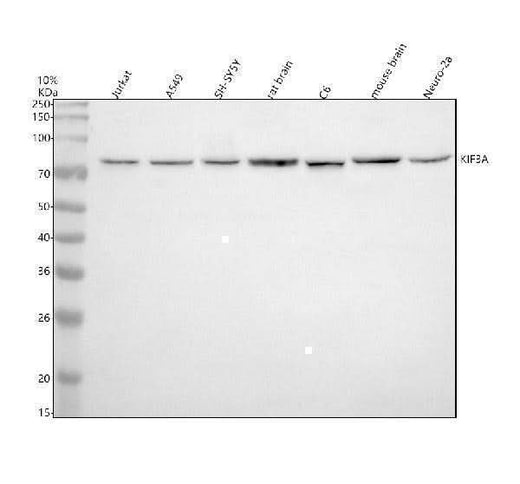
Boster Bio Anti-KIF3A Antibody Picoband® catalog # PB9654. Tested in WB applications. This antibody reacts with Human, Mouse, Rat. The brand Picoband indicates this is a premium antibody that guarantees superior quality, high affinity, and strong signals with minimal background in Western blot applications. Only our best-performing antibodies are designated as Picoband, ensuring unmatched performance.Kinesin-like protein KIF3A is a protein that in humans is encoded by the KIF3A gene. KIF3A is one subunit of the heterotrimeric motor protein, kinesin-2, that was initially isolated from sea urchin egg/embryo cytosol using microtubule affinity purification. This motor consists of two kinesin-related subunits (called KIF3A and KIF3B or 3C in vertebrates) and an associated protein (KAP3), and it transports protein complexes, nucleic acids and organelles towards the plus ends of microtubule tracks within cells. Work done in a broad range of eukaryotic cells has revealed that heterotrimeric kinesin-2 is the primary motor protein driving the intra-flagellar transport of tubulins and other axonemal building blocks from the base of the ciliary/flagellar axoneme to their site of assembly at the distal tips. This process is required for cilium assembly/maintenance and cilium-based signalling which play key roles in various cell and developmental processes. For example, in vertebrate embryos, kinesin-2 function is required for cilia-dependent nodal flow and the development of left-right asymmetry.
| Collaborator | Boster Bio |
| Partner model | PB9654 |
| Target | Kinesin-like protein KIF3A |
| Reactivity | Human,Mouse,Rat |
| Applications | ELISA,Flow Cytometry,IHC,IHC-P,WB |
| Conjugation | Unconjugated|Biotin|Cy3|Fluoro488|Fluoro550|Fluoro594|FITC|HRP|APC|PE|Fluoro647 |
| Cross-reactivity | No cross-reactivity with other proteins |
| Dilution range | Western blot, 0.1-0.5μg/ml, Human, Mouse, Rat<br> |
| Host | Rabbit |
| Clonality | Polyclonal |
| Isotype | Rabbit IgG |
| Immunogen | E.coli-derived human KIF3A recombinant protein (Position: D485-Q699). Human KIF3A shares 97.7% amino acid (aa) sequence identity with mouse KIF3A. |
| Concentration | Adding 0.2 ml of distilled water will yield a concentration of 500 μg/ml. |
| Purification | Immunogen affinity purified. |
| Purity | No cross reactivity with other proteins. |
| Shelf life | Store at -20℃ for one year from date of receipt. After reconstitution, at 4℃ for one month. It can also be aliquotted and stored frozen at -20℃ for six months. Avoid repeated freeze-thaw cycles. |
| Availability | Available |
| Species | WB | IHC | IHC-P | IHC-F | IF/ICC | Flow Cytometry | ELISA | IP |
|---|---|---|---|---|---|---|---|---|
| Human | ||||||||
| Mouse | ||||||||
| Rat |
Collaborator meets ABMIUM quality standards and overall product performance standards have been met.
For research applications. Not for diagnostic use.
No customer reviews yet.