Anti-Glucocorticoid Receptor/NR3C1 Antibody Picoband®
Primary Antibody supplied by Boster Bio Read more ›

Product Description
The glucocorticoid receptor (GR, or GCR), also known as NR3C1, is the receptor to which cortisol and other glucocorticoids bind. In humans, the GR protein is encoded by NR3C1 gene which is located on chromosome 5 (5q31). GR is expressed in almost every cell in the body and regulates genes controlling the development, metabolism, and immune response. Because the receptor gene is expressed in several forms, it has many different (pleiotropic) effects in different parts of the body. The activated GR complex up-regulates the expression of anti-inflammatory proteins in the nucleus or represses the expression of pro-inflammatory proteins in the cytosol (by preventing the translocation of other transcription factors from the cytosol into the nucleus).
Product information
| Supplier | Boster Bio |
|---|---|
| ABMIUM evidence status | ABMIUM Verified™ collaborator-tested data |
| Catalogue reference | PB9232 |
| Product category | Primary Antibodies |
| Reactive species | Human |
| Tested applications | ELISA, Flow Cytometry, IF/ICC, IHC, IHC-P, WB |
| Available conjugations | Unconjugated, Biotin, Cy3, Fluoro488, Fluoro550, Fluoro594, FITC, HRP, APC, PE, Fluoro647 |
| Gene name | NR3C1 |
| Protein name | Glucocorticoid receptor |
| Specificity | No cross reactivity with other proteins. |
| Immunogen | E.coli-derived human NR3C1 recombinant protein (Position: M1-D373). Human NR3C1 shares 85% and 82% amino acid (aa) sequences identity with mouse and rat NR3C1, respectively. |
| Host | Rabbit |
| Clonality | Polyclonal |
| Isotype | Rabbit IgG |
| Purification | Immunogen affinity purified. |
| Storage | Store at -20℃ for one year from date of receipt. After reconstitution, at 4℃ for one month. It can also be aliquotted and stored frozen at -20℃ for six months. Avoid repeated freeze-thaw cycles. |
| UniProt | P04150 |
| NCBI Gene ID | 2908 |
Available variants
| Conjugation | Size |
|---|---|
| Unconjugated | 100 μg/vial |
| Biotin | 100 μg/vial |
| Cy3 | 100 μg/vial |
| Fluoro488 | 100 μg/vial |
| Fluoro550 | 100 μg/vial |
| Fluoro594 | 100 μg/vial |
| FITC | 100 μg/vial |
| HRP | 100 μg/vial |
| APC | 100 μg/vial |
| PE | 100 μg/vial |
| Fluoro647 | 100 μg/vial |
Key Facts
| Target | Glucocorticoid receptor |
| Also known as | GCCR; GCR; Glucocorticoid receptor; GR; GRL; NR3C1 |
| Concentration | Adding 0.2 ml of distilled water will yield a concentration of 500 μg/ml. |
| Species reactivity | Human |
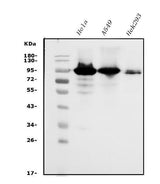
| Observed band | 95 kDa |
| Purity | No cross reactivity with other proteins. |
| Form / buffer | Lyophilized |
| Shelf life | Store at -20℃ for one year from date of receipt. After reconstitution, at 4℃ for one month. It can also be aliquotted and stored frozen at -20℃ for six months. Avoid repeated freeze-thaw cycles. |
| Host species | Rabbit |
| Clonality | Polyclonal |
| Isotype | Rabbit IgG |
| Conjugation | Unconjugated|Biotin|Cy3|Fluoro488|Fluoro550|Fluoro594|FITC|HRP|APC|PE|Fluoro647 |
| Non-cross-reactive with | No cross-reactivity with other proteins |
| Tested applications |
ELISAFlow CytometryIF/ICCIHCIHC-PWB |
| Dilution range | Western blot, 0.1-0.5μg/ml, Human Immunohistochemistry (Paraffin-embedded Section), 2-5μg/ml, Human Immunocytochemistry/Immunofluorescence, 5μg/ml, Human Flow Cytometry (Fixed), 1-3μg/1x106 cells, Human |
| Immunogen | E.coli-derived human NR3C1 recombinant protein (Position: M1-D373). Human NR3C1 shares 85% and 82% amino acid (aa) sequences identity with mouse and rat NR3C1, respectively. |
| Purification | Immunogen affinity purified. |
Reactivity & Application Validation
1 species| Species | WB | IHC | IHC-P | IHC-F | IF/ICC | FLOW CYTOMETRY | ELISA | IP |
|---|---|---|---|---|---|---|---|---|
| Human |
Specifications
Immunohistochemistry (Paraffin-embedded Section), 2-5μg/ml, Human
Immunocytochemistry/Immunofluorescence, 5μg/ml, Human
Flow Cytometry (Fixed), 1-3μg/1x106 cells, Human
Storage & Stability
Compliance & Certifications
Not intended for diagnostic or therapeutic use.