
Primary Antibody supplied by Boster Bio Read more ›

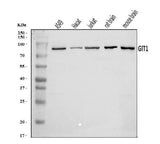
Anti-GIT1 Antibody Picoband® is a research-use antibody from Boster Bio for studying ARF GTPase-activating protein GIT1 in ELISA, Flow Cytometry, IF/ICC, IHC, IHC-P, WB workflows with listed reactivity for Human, Mouse, Rat. Specifications and supporting documents below should be reviewed when planning the experiment.
Boster Bio Anti-GIT1 Antibody Picoband® catalog # A02140-3. Tested in ELISA, Flow Cytometry, IF, IHC, ICC, WB applications. This antibody reacts with Human, Mouse, Rat. The brand Picoband indicates this is a premium antibody that guarantees superior quality, high affinity, and strong signals with minimal background in Western blot applications. Only our best-performing antibodies are designated as Picoband, ensuring unmatched performance.ARF GTPase-activating protein GIT1 is an enzyme that in humans is encoded by the GIT1 gene. G-protein coupled receptor (GPCR) kinase interacting proteins 1 and 2 (GIT-1 and GIT-2) are highly conserved, ubiquitous scaffold proteins involved in localized signaling to help regulate focal contact assembly and cytoskeletal dynamics. GIT proteins contain multiple interaction domains that allow interaction with small GTPases (including ARF, Rac and cdc42), kinases (such as PAK and MEK), the Rho family GEF PIX, and the focal adhesion protein paxillin. GIT-1 is localized to focal adhesions, cytoplasmic complexes and membrane protrusions, and regulates cell protrusion formation and cell migration. GIT-1 has also been implicated in neuronal functions including synapse formation and the pathology of Huntington disease. Huntington disease is a genetic neurodegenerative condition involving a mutation in the huntington gene. The huntington gene product (htt) is ubiquitinated and degraded in human Huntington disease brains. Htt interacts ly with GIT-1 causing enhanced htt proteolysis, indicating that GIT-1 distribution and function may contribute to Huntington disease pathology.
| Collaborator | Boster Bio |
| Partner model | A02140-3 |
| Target | ARF GTPase-activating protein GIT1 |
| Reactivity | Human,Mouse,Rat |
| Applications | ELISA,Flow Cytometry,IF/ICC,IHC,IHC-P,WB |
| Conjugation | Unconjugated|Biotin|Cy3|Fluoro488|Fluoro550|Fluoro594|FITC|HRP|APC|PE|Fluoro647 |
| Cross-reactivity | No cross-reactivity with other proteins. |
| Dilution range | Western blot, 0.25-0.5 μg/ml, Human, Mouse, Rat<br> Immunohistochemistry(Paraffin-embedded Section), 2-5 μg/ml, Human, Mouse, Rat<br> Immunocytochemistry/Immunofluorescence, 5 μg/ml, Human<br> Flow Cytometry (Fixed), 1-3 μg/1x10<sup>6</sup> cells, Human<br> ELISA, 0.1-0.5 μg/ml, -<br> |
| Host | Rabbit |
| Clonality | Polyclonal |
| Isotype | Rabbit IgG |
| Immunogen | E.coli-derived human GIT1 recombinant protein (Position: D415-Q736). |
| Concentration | Adding 0.2 ml of distilled water will yield a concentration of 500 μg/ml. |
| Purification | Immunogen affinity purified. |
| Shelf life | At -20℃ for one year from date of receipt. After reconstitution, at 4℃ for one month. It can also be aliquotted and stored frozen at -20℃ for six months. Avoid repeated freezing and thawing. |
| Availability | Available |
| Species | WB | IHC | IHC-P | IHC-F | IF/ICC | Flow Cytometry | ELISA | IP |
|---|---|---|---|---|---|---|---|---|
| Human | ||||||||
| Mouse | ||||||||
| Rat |
Collaborator meets ABMIUM quality standards and overall product performance standards have been met.
For research applications. Not for diagnostic use.
No customer reviews yet.
