
Primary Antibody supplied by Boster Bio Read more ›

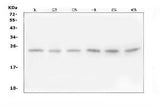
Anti-Follistatin-related protein 3 FSTL3 Antibody Picoband® is a research-use antibody from Boster Bio for studying Follistatin-related protein 3 in ELISA, Flow Cytometry, IHC, IHC-P, WB workflows with listed reactivity for Human, Mouse, Rat. Specifications and supporting documents below should be reviewed when planning the experiment.
Boster Bio Anti-Follistatin-related protein 3 FSTL3 Antibody catalog # PA1915. Tested in WB applications. This antibody reacts with Human, Mouse, Rat. The brand Picoband indicates this is a premium antibody that guarantees superior quality, high affinity, and strong signals with minimal background in Western blot applications. Only our best-performing antibodies are designated as Picoband, ensuring unmatched performance.FSTL3 (Follistatin-Like 3) also known as FLRG or FOLLISTATIN-RELATED GENE, is a member of the follistatin-module protein family, which is composed of extracellular matrix-associated glycoproteins though to act in a paracrine manner to bind morphogens or growth/differentiation factors and regulate their activity during development. The FSTL3 gene extends over 7 kbp and contains 5 exons. By Southern blot analysis of somatic cell hybrids and FISH, Hayette et al. (1998) localized the FSTL3 gene to chromosome 19p13. Using recombinant mouse Fstl3, Tsuchida et al. (2000) found that Fstl3bound both activin and BMP2 and had a higher affinity for activin. Overexpression of Fstl3 inhibited BMP2-induced cell signaling in a reporter assay. In addition to the translocation in a case of B-cell chronic lymphocytic leukemia from which FSTL3 was isolated, Hayette et al. (1998) also observed rearrangement of the FSTL3 gene in a case of B-cell non-Hodgkin lymphoma and in a case of B-cell mantle zone lymphoma, suggesting that FSTL3 may be involved in the leukemogenesis process.
| Supplier | Boster Bio |
|---|---|
| ABMIUM evidence status | ABMIUM Verified™ collaborator-tested data |
| Catalogue reference | PA1915 |
| Product category | Primary Antibodies |
| Reactive species | Human, Mouse, Rat |
| Tested applications | ELISA, Flow Cytometry, IHC, IHC-P, WB |
| Available conjugations | Unconjugated, Biotin, Cy3, Fluoro488, Fluoro550, Fluoro594, FITC, HRP, APC, PE, Fluoro647 |
| Gene name | FSTL3 |
| Protein name | Follistatin-related protein 3 |
| Specificity | No cross reactivity with other proteins. |
| Immunogen | A synthetic peptide corresponding to a sequence in the middle region of human FSTL3, different from the related rat and mouse sequences by one amino acid. |
| Host | Rabbit |
| Clonality | Polyclonal |
| Isotype | Rabbit IgG |
| Purification | Immunogen affinity purified. |
| Storage | Store at -20℃ for one year from date of receipt. After reconstitution, at 4℃ for one month. It can also be aliquotted and stored frozen at -20℃ for six months. Avoid repeated freeze-thaw cycles. |
| UniProt | O95633 |
| NCBI Gene ID | 10272 |
| Conjugation | Size |
|---|---|
| Unconjugated | 100 μg/vial |
| Biotin | 100 μg/vial |
| Cy3 | 100 μg/vial |
| Fluoro488 | 100 μg/vial |
| Fluoro550 | 100 μg/vial |
| Fluoro594 | 100 μg/vial |
| FITC | 100 μg/vial |
| HRP | 100 μg/vial |
| APC | 100 μg/vial |
| PE | 100 μg/vial |
| Fluoro647 | 100 μg/vial |
| Collaborator | Boster Bio |
| Partner model | PA1915 |
| Target | Follistatin-related protein 3 |
| Reactivity | Human,Mouse,Rat |
| Applications | ELISA,Flow Cytometry,IHC,IHC-P,WB |
| Conjugation | Unconjugated|Biotin|Cy3|Fluoro488|Fluoro550|Fluoro594|FITC|HRP|APC|PE|Fluoro647 |
| Cross-reactivity | No cross-reactivity with other proteins |
| Dilution range | Western blot, 0.1-0.5μg/ml, Human, Mouse, Rat<br> |
| Host | Rabbit |
| Clonality | Polyclonal |
| Isotype | Rabbit IgG |
| Immunogen | A synthetic peptide corresponding to a sequence in the middle region of human FSTL3, different from the related rat and mouse sequences by one amino acid. |
| Concentration | Adding 0.2 ml of distilled water will yield a concentration of 500 μg/ml. |
| Purification | Immunogen affinity purified. |
| Purity | No cross reactivity with other proteins. |
| Shelf life | Store at -20℃ for one year from date of receipt. After reconstitution, at 4℃ for one month. It can also be aliquotted and stored frozen at -20℃ for six months. Avoid repeated freeze-thaw cycles. |
| Availability | Available |
| Species | WB | IHC | IHC-P | IHC-F | IF/ICC | Flow Cytometry | ELISA | IP |
|---|---|---|---|---|---|---|---|---|
| Human | ||||||||
| Mouse | ||||||||
| Rat |
Collaborator meets ABMIUM quality standards and overall product performance standards have been met.
For research applications. Not for diagnostic use.
No customer reviews yet.
