
Primary Antibody supplied by Boster Bio Read more ›

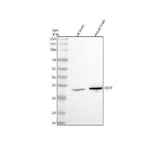
Anti-DIO2 Antibody Picoband® is a research-use antibody from Boster Bio for studying Type II iodothyronine deiodinase in ELISA, Flow Cytometry, IHC, IHC-P, WB workflows with listed reactivity for Rat. Specifications and supporting documents below should be reviewed when planning the experiment.
Boster Bio Anti-DIO2 Antibody Picoband® catalog # A02249-2. Tested in WB applications. This antibody reacts with Rat. The brand Picoband indicates this is a premium antibody that guarantees superior quality, high affinity, and strong signals with minimal background in Western blot applications. Only our best-performing antibodies are designated as Picoband, ensuring unmatched performance.The protein encoded by this gene belongs to the iodothyronine deiodinase family. It catalyzes the conversion of prohormone thyroxine (3,5,3',5'-tetraiodothyronine, T4) to the bioactive thyroid hormone (3,5,3'-triiodothyronine, T3) by outer ring 5'-deiodination. This gene is widely expressed, including in thyroid and brain. It is thought to be responsible for the 'local' production of T3, and thus important in influencing thyroid hormone action in these tissues. It has also been reported to be highly expressed in thyroids of patients with Graves disease, and in follicular adenomas. The intrathyroidal T4 to T3 conversion by this enzyme may contribute significantly to the relative increase in thyroidal T3 production in these patients. This protein is a selenoprotein containing the non-standard amino acid, selenocysteine (Sec), which is encoded by the UGA codon that normally signals translation termination. The 3' UTRs of selenoprotein mRNAs contain a conserved stem-loop structure, designated the Sec insertion sequence (SECIS) element, that is necessary for the recognition of UGA as a Sec codon, rather than as a stop signal. Unlike the other two members (DIO1 and DIO3) of this enzyme family, the mRNA for this gene contains an additional in-frame UGA codon that has been reported (in human) to function either as a Sec or a stop codon, which can result in two isoforms with one or two Sec residues; however, only the upstream Sec (conserved with the single Sec residue found at the active site in DIO1 and DIO3) was shown to be essential for enzyme activity (PMID:10403186). Alternatively spliced transcript variants have been described for this gene.
| Collaborator | Boster Bio |
| Partner model | A02249-2 |
| Target | Type II iodothyronine deiodinase |
| Reactivity | Rat |
| Applications | ELISA,Flow Cytometry,IHC,IHC-P,WB |
| Conjugation | Unconjugated|Biotin|Cy3|Fluoro488|Fluoro550|Fluoro594|FITC|HRP|APC|PE|Fluoro647 |
| Cross-reactivity | No cross-reactivity with other proteins |
| Dilution range | Western blot, 0.25-0.5 μg/ml, Rat<br> |
| Host | Rabbit |
| Clonality | Polyclonal |
| Isotype | Rabbit IgG |
| Immunogen | A synthetic peptide corresponding to a sequence at the N-terminus of human DIO2, which shares 95.7% amino acid (aa) sequence identity with both mouse and rat DIO2. |
| Concentration | Adding 0.2 ml of distilled water will yield a concentration of 500 μg/ml. |
| Purification | Immunogen affinity purified. |
| Shelf life | At -20°C for one year from date of receipt. After reconstitution, at 4°C for one month. It can also be aliquotted and stored frozen at -20°C for six months. Avoid repeated freezing and thawing. |
| Availability | Available |
| Species | WB | IHC | IHC-P | IHC-F | IF/ICC | Flow Cytometry | ELISA | IP |
|---|---|---|---|---|---|---|---|---|
| Rat |
Collaborator meets ABMIUM quality standards and overall product performance standards have been met.
For research applications. Not for diagnostic use.
No customer reviews yet.
