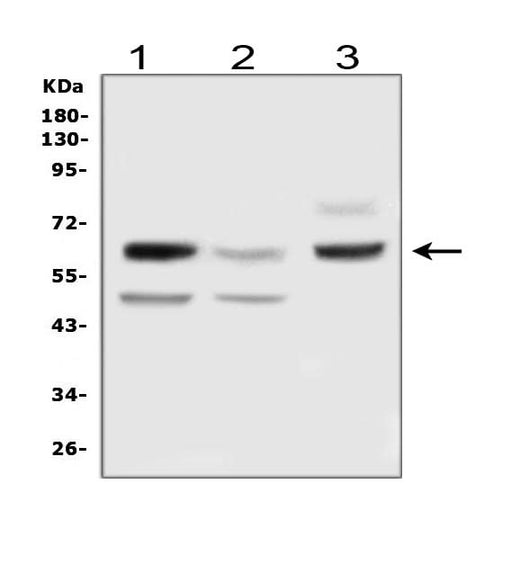
Primary Antibody supplied by Boster Bio Read more ›


Anti-Delta-like protein 3 DLL3 Antibody Picoband® is a research-use antibody from Boster Bio for studying Delta-like protein 3 in ELISA, Flow Cytometry, IHC, IHC-P, WB workflows with listed reactivity for Human. Specifications and supporting documents below should be reviewed when planning the experiment.
Boster Bio Anti-Delta-like protein 3 DLL3 Antibody catalog # PA1912. Tested in WB applications. This antibody reacts with Human. The brand Picoband indicates this is a premium antibody that guarantees superior quality, high affinity, and strong signals with minimal background in Western blot applications. Only our best-performing antibodies are designated as Picoband, ensuring unmatched performance.DLL3 (DELTA-LIKE 3) also known as DELTA, DROSOPHILA, HOMOLOG OF, is a protein which in humans is encoded by the DLL3 gene. This gene encodes a member of the delta protein ligand family. This family functions as Notch ligands that are characterized by a DSL domain, EGF repeats, and a transmembrane domain. Mutation in the mouse delta-like 3 gene (Dll3), which is homologous to the Notch-ligand delta in Drosophila, results in the mouse 'pudgy' phenotype. The human DLL3 gene was identified within a critical interval, mapped in 2 consanguineous Arab-Israeli and Pakistani SCDO1 pedigrees, of 7.8 cM at 19q13.1-q13.3 between D19S570 and D19S908 (Bulman et al., 2000). Dunwoodie et al. (1997) presented results suggesting that mouse Dll3 may complement the function of other delta homologs during early pattern formation in the mouse embryo. In humans, the fact that mutations in genes required for oscillation, such as DLL3, result in abnormal segmentation of the vertebral column suggests that the segmentation clock also acts during human embryonic development. This residue is highly conserved in Delta proteins from Drosophila to humans, and the substitution of a charged polar for a nonpolar residue may disrupt the conformation of the DLL3 protein.
| Supplier | Boster Bio |
|---|---|
| ABMIUM evidence status | ABMIUM Verified™ collaborator-tested data |
| Catalogue reference | PA1912 |
| Product category | Primary Antibodies |
| Reactive species | Human |
| Tested applications | ELISA, Flow Cytometry, IHC, IHC-P, WB |
| Available conjugations | Unconjugated, Biotin, Cy3, Fluoro488, Fluoro550, Fluoro594, FITC, HRP, APC, PE, Fluoro647 |
| Gene name | DLL3 |
| Protein name | Delta-like protein 3 |
| Specificity | No cross reactivity with other proteins. |
| Immunogen | A synthetic peptide corresponding to a sequence at the C-terminus of human DLL3. |
| Host | Rabbit |
| Clonality | Polyclonal |
| Isotype | Rabbit IgG |
| Purification | Immunogen affinity purified. |
| Storage | Store at -20℃ for one year from date of receipt. After reconstitution, at 4℃ for one month. It can also be aliquotted and stored frozen at -20℃ for six months. Avoid repeated freeze-thaw cycles. |
| UniProt | Q9NYJ7 |
| NCBI Gene ID | 10683 |
| Conjugation | Size |
|---|---|
| Unconjugated | 100 μg/vial |
| Biotin | 100 μg/vial |
| Cy3 | 100 μg/vial |
| Fluoro488 | 100 μg/vial |
| Fluoro550 | 100 μg/vial |
| Fluoro594 | 100 μg/vial |
| FITC | 100 μg/vial |
| HRP | 100 μg/vial |
| APC | 100 μg/vial |
| PE | 100 μg/vial |
| Fluoro647 | 100 μg/vial |
| Collaborator | Boster Bio |
| Partner model | PA1912 |
| Target | Delta-like protein 3 |
| Reactivity | Human |
| Applications | ELISA,Flow Cytometry,IHC,IHC-P,WB |
| Conjugation | Unconjugated|Biotin|Cy3|Fluoro488|Fluoro550|Fluoro594|FITC|HRP|APC|PE|Fluoro647 |
| Cross-reactivity | No cross-reactivity with other proteins |
| Dilution range | Western blot, 0.1-0.5μg/ml, Human<br> |
| Host | Rabbit |
| Clonality | Polyclonal |
| Isotype | Rabbit IgG |
| Immunogen | A synthetic peptide corresponding to a sequence at the C-terminus of human DLL3. |
| Concentration | Adding 0.2 ml of distilled water will yield a concentration of 500 μg/ml. |
| Purification | Immunogen affinity purified. |
| Purity | No cross reactivity with other proteins. |
| Shelf life | Store at -20℃ for one year from date of receipt. After reconstitution, at 4℃ for one month. It can also be aliquotted and stored frozen at -20℃ for six months. Avoid repeated freeze-thaw cycles. |
| Availability | Available |
| Species | WB | IHC | IHC-P | IHC-F | IF/ICC | Flow Cytometry | ELISA | IP |
|---|---|---|---|---|---|---|---|---|
| Human |
Collaborator meets ABMIUM quality standards and overall product performance standards have been met.
For research applications. Not for diagnostic use.
No customer reviews yet.