
Anti-Bmi1 Antibody Picoband®
Primary Antibody supplied by Boster Bio Read more ›

Product Description
BMI1 (BMI1 polycomb ring finger oncogene), also known as RNF51, is a protein which in humans is encoded by the BMI1 gene. The Bmi1 gene is highly conserved in evolution as indicated by zoo blot hybridization with Bmi1 probes corresponding to the protein-encoding domain. By fluorescence in situ hybridization, the human BMI1 gene is assigned to chromosome 10p13. BMI1 has a key role in regulating the proliferative activity of normal stem and progenitor cells. Most importantly, they provided evidence that the proliferative potential of leukemic stem and progenitor cells lacking BMI1 is compromised because they eventually undergo proliferation arrest and show signs of differentiation and apoptosis, leading to transplant failure of the leukemia. Complementation studies showed that BMI1 completely rescues these proliferative defects. Deletion analysis showed that the RING finger and helix-turn-helix domains of BMI1 were required for life span extension and repression of the tumor suppressor p16 (INK4). BMI1 selectively extended the life span of these cultures. Confocal microscopy showed that BMI1 transiently colocalized with centromeres during interphase in HeLa cells.
Product information
| Supplier | Boster Bio |
|---|---|
| ABMIUM evidence status | ABMIUM Verified™ collaborator-tested data |
| Catalogue reference | PB9133 |
| Product category | Primary Antibodies |
| Reactive species | Human, Mouse, Rat |
| Tested applications | ELISA, Flow Cytometry, IHC, IHC-P, WB |
| Available conjugations | Unconjugated, Biotin, Cy3, Fluoro488, Fluoro550, Fluoro594, FITC, HRP, APC, PE, Fluoro647 |
| Gene name | BMI1 |
| Protein name | Polycomb complex protein BMI-1 |
| Specificity | No cross reactivity with other proteins. |
| Immunogen | A synthetic peptide corresponding to a sequence in the middle region of human Bmi1, different from the related mouse sequence by four amino acids. |
| Host | Rabbit |
| Clonality | Polyclonal |
| Isotype | Rabbit IgG |
| Purification | Immunogen affinity purified. |
| Storage | Store at -20℃ for one year from date of receipt. After reconstitution, at 4℃ for one month. It can also be aliquotted and stored frozen at -20℃ for six months. Avoid repeated freeze-thaw cycles. |
| UniProt | P35226 |
| NCBI Gene ID | 648 |
Available variants
| Conjugation | Size |
|---|---|
| Unconjugated | 100 μg/vial |
| Biotin | 100 μg/vial |
| Cy3 | 100 μg/vial |
| Fluoro488 | 100 μg/vial |
| Fluoro550 | 100 μg/vial |
| Fluoro594 | 100 μg/vial |
| FITC | 100 μg/vial |
| HRP | 100 μg/vial |
| APC | 100 μg/vial |
| PE | 100 μg/vial |
| Fluoro647 | 100 μg/vial |
Key Facts
| Target | Polycomb complex protein BMI-1 |
| Also known as | BMI1; PCGF4; Polycomb complex protein BMI 1; RING finger protein 51; RNF51 |
| Concentration | Adding 0.2 ml of distilled water will yield a concentration of 500 μg/ml. |
| Species reactivity | Human,Mouse,Rat |
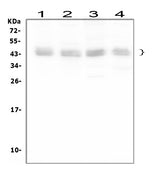
| Observed band | 43-45 kDa |
| Purity | No cross reactivity with other proteins. |
| Form / buffer | Lyophilized |
| Shelf life | Store at -20℃ for one year from date of receipt. After reconstitution, at 4℃ for one month. It can also be aliquotted and stored frozen at -20℃ for six months. Avoid repeated freeze-thaw cycles. |
| Host species | Rabbit |
| Clonality | Polyclonal |
| Isotype | Rabbit IgG |
| Conjugation | Unconjugated|Biotin|Cy3|Fluoro488|Fluoro550|Fluoro594|FITC|HRP|APC|PE|Fluoro647 |
| Non-cross-reactive with | No cross-reactivity with other proteins |
| Tested applications |
ELISAFlow CytometryIHCIHC-PWB |
| Dilution range | Western blot, 0.1-0.5μg/ml, Human, Mouse, Rat |
| Immunogen | A synthetic peptide corresponding to a sequence in the middle region of human Bmi1, different from the related mouse sequence by four amino acids. |
| Purification | Immunogen affinity purified. |
Reactivity & Application Validation
3 speciess| Species | WB | IHC | IHC-P | IHC-F | IF/ICC | FLOW CYTOMETRY | ELISA | IP |
|---|---|---|---|---|---|---|---|---|
| Human | ||||||||
| Mouse | ||||||||
| Rat |
Specifications
Storage & Stability
*This antibody is supplied in a stabilized formulation.
Compatibility with conjugation reactions depends on the chemistry of the conjugation method used.
For conjugation methods that are not compatible with the stabilizing components present in this formulation, a carrier-free antibody format is required.
Compliance & Certifications
Not intended for diagnostic or therapeutic use.