Primary Antibody supplied by Boster Bio Read more ›


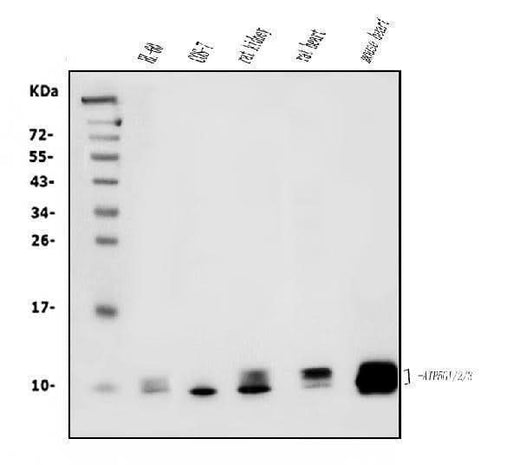
Anti-ATP5F1,2,3/ATP5MC1,2,3 Picoband® Antibody (monoclonal, 12E9 is a research-use antibody from Boster Bio for studying ATP synthase F in ELISA, Flow Cytometry, IHC, IHC-P, WB workflows with listed reactivity for Human, Mouse, Rat, Monkey. Specifications and supporting documents below should be reviewed when planning the experiment.
Boster Bio Anti-ATP5F1,2,3/ATP5MC1,2,3 Picoband® Antibody (monoclonal, 12E9) catalog # M09735. Tested in Flow Cytometry, WB applications. This antibody reacts with Human, Monkey, Mouse, Rat. The brand Picoband indicates this is a premium antibody that guarantees superior quality, high affinity, and strong signals with minimal background in Western blot applications. Only our best-performing antibodies are designated as Picoband, ensuring unmatched performance.The ATP5MC1 gene is one of three human paralogs that encode membrane subunit c of the mitochondrial ATP synthase. It is mapped to 17q21.32. This gene encodes a subunit of mitochondrial ATP synthase. Mitochondrial ATP synthase catalyzes ATP synthesis, utilizing an electrochemical gradient of protons across the inner membrane during oxidative phosphorylation. ATP synthase is composed of two linked multi-subunit complexes: the soluble catalytic core, F1, and the membrane-spanning component, Fo, comprising the proton channel. The catalytic portion of mitochondrial ATP synthase consists of 5 different subunits (alpha, beta, gamma, delta, and epsilon) assembled with a stoichiometry of 3 alpha, 3 beta, and a single representative of the other 3. The proton channel seems to have nine subunits (a, b, c, d, e, f, g, F6 and 8). This gene is one of three genes that encode subunit c of the proton channel. Each of the three genes have distinct mitochondrial import sequences but encode the identical mature protein. Alternatively spliced transcript variants encoding the same protein have been identified.
| Collaborator | Boster Bio |
| Partner model | M09735 |
| Target | ATP synthase F |
| Reactivity | Human,Mouse,Rat,Monkey |
| Applications | ELISA,Flow Cytometry,IHC,IHC-P,WB |
| Conjugation | Unconjugated|Biotin|Cy3|Fluoro488|Fluoro550|Fluoro594|FITC|HRP|APC|PE|Fluoro647 |
| Cross-reactivity | No cross-reactivity with other proteins. |
| Dilution range | Western blot, 0.25-0.5μg/ml, Human, Mouse, Rat, Monkey<br> Flow Cytometry (Fixed), 1-3μg/1x10<sup>6</sup> cells, Human, Mouse, Rat<br> |
| Host | Mouse |
| Clonality | Monoclonal |
| Clone | Clone: 12E9 |
| Isotype | Mouse IgG2b |
| Immunogen | E.coli-derived human ATP5G1,2,3/ATP5MC1,2,3 recombinant protein (Position: D62-L113). |
| Concentration | Adding 0.2 ml of distilled water will yield a concentration of 500 μg/ml. |
| Purification | Immunogen affinity purified. |
| Shelf life | Store at -20℃ for one year from date of receipt. After reconstitution, at 4℃ for one month. It can also be aliquotted and stored frozen at -20℃ for six months. Avoid repeated freeze-thaw cycles. |
| Availability | Available |
| Species | WB | IHC | IHC-P | IHC-F | IF/ICC | Flow Cytometry | ELISA | IP |
|---|---|---|---|---|---|---|---|---|
| Human | ||||||||
| Mouse | ||||||||
| Rat | ||||||||
| Monkey |
Collaborator meets ABMIUM quality standards and overall product performance standards have been met.
For research applications. Not for diagnostic use.
No customer reviews yet.