
A Cyclase V/VI rabbit pAb from ELK Biotechnology Read more ›

A Cyclase V/VI rabbit pAb is a research-use antibody from ELK Biotechnology for studying ADCY5 in IHC, IF, ELISA workflows with listed reactivity for Human, Mouse, Rat. Specifications and supporting documents below should be reviewed when planning the experiment.
This gene encodes a member of the adenylyl cyclase family of proteins, which are required for the synthesis of cyclic AMP. All members of this family have an intracellular N-terminus, a tandem repeat of six transmembrane domains separated by a cytoplasmic loop, and a C-terminal cytoplasmic domain. The two cytoplasmic regions bind ATP and form the catalytic core of the protein. Adenylyl cyclases are important effectors of transmembrane signaling pathways and are regulated by the activity of G protein coupled receptor signaling. This protein belongs to a small subclass of adenylyl cyclase proteins that are functionally related and are inhibited by protein kinase A, calcium ions and nitric oxide. A mutation in this gene is associated with arthrogryposis multiplex congenita. [provided by RefSeq, May 2015],
| Specificity | A Cyclase V/VI Polyclonal Antibody detects endogenous levels of A Cyclase V/VI protein. |
|---|---|
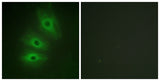
| Validation evidence captions | Immunofluorescence analysis of HeLa cells, using ADCY5/6 Antibody. The picture on the right is blocked with the synthesized peptide. | Immunohistochemistry analysis of paraffin-embedded human brain tissue, using ADCY5/6 Antibody. The picture on the right is blocked with the synthesized peptide. |
| Collaborator | ELK Biotechnology |
| Partner model | ES4608 |
| Target | ADCY5 |
| Research areas | >>Purine metabolism, >>Metabolic pathways, >>Endocrine resistance, >>Rap1 signaling pathway, >>cGMP-PKG signaling pathway, >>cAMP signaling pathway, >>Chemokine signaling pathway, >>Phospholipase D signaling pathway, >>Oocyte meiosis, >>Longevity regulating pathway, >>Longevity regulating pathway - multiple species, >>Adrenergic signaling in cardiomyocytes, >>Vascular smooth muscle contraction, >>Apelin signaling pathway, >>Gap junction, >>Platelet activation, >>Circadian entrainment, >>Thermogenesis, >>Retrograde endocannabinoid signaling, >>Glutamatergic synapse, >>Cholinergic synapse, >>GABAergic synapse, >>Taste transduction, >>Inflammatory mediator regulation of TRP channels, >>Insulin secretion, >>GnRH signaling pathway, >>Ovarian steroidogenesis, >>Progesterone-mediated oocyte maturation, >>Estrogen signaling pathway, >>Melanogenesis, >>Thyroid hormone synthesis, >>Oxytocin signaling pathway, >>Regulation of lipolysis in adipocytes, >>Renin secretion, >>Aldosterone synthesis and secretion, >>Relaxin signaling pat |
| Reactivity | Human,Mouse,Rat |
| Applications | IHC,IF,ELISA |
| Conjugation | Unconjugated |
| Dilution range | Immunohistochemistry: 1/100 - 1/300. Immunofluorescence: 1/200 - 1/1000. ELISA: 1/20000. Not yet tested in other applications. |
| Host | Rabbit |
| Clonality | Polyclonal |
| Isotype | IgG |
| Immunogen | The antiserum was produced against synthesized peptide derived from human ADCY5/6. AA range:931-980 |
| Concentration | 1 mg/ml |
| Purification | The antibody was affinity-purified from rabbit antiserum by affinity-chromatography using epitope-specific immunogen. |
| Assay type | Antibody validation/application |
| Expression system | Detected in peripheral blood mononuclear leukocytes (at protein level) (PubMed:17916776). Detected in thyroid (PubMed:10978539). |
| Purity | The antibody was affinity-purified from rabbit antiserum by affinity-chromatography using epitope-specific immunogen. |
| Species | WB | IHC | IF | ELISA | IP | FCM | ChIP |
|---|---|---|---|---|---|---|---|
| Human | |||||||
| Mouse | |||||||
| Rat |
| Species | Dilution | Notes |
|---|---|---|
| Human | Immunohistochemistry: 1/100 - 1/300. Immunofluorescence: 1/200 - 1/1000. ELISA: 1/20000. Not yet tested in other applications. | — |
| Mouse | — | — |
| Rat | — | — |
| Species | Dilution | Notes |
|---|
| Species | Dilution | Notes |
|---|
Collaborator meets ABMIUM quality standards and overall product performance standards have been met.
Quality management certification.
For research applications. Not for diagnostic use.
No customer reviews yet.
