Manufactured by:ELK Biotechnology
RUO

Kit ELISA du BDNF (facteur neurotrophique dérivé du cerveau) canin

Kit ELISA du BDNF (Brain Derived Neurotrophic Factor) canin de ELK Biotechnology

SKU:
ABM70127
Product type
Kits ELISA
TargetBDNF
ApplicationsELISA
Species / reactivityChien
Sample typeSérum, plasma, homogénats tissulaires, lysats cellulaires, surnageants de culture cellulaire, autres fluides biologiques

Manufacturer provenance

Manufactured by:
ELK Biotechnology
Sold by:
ABMIUM
Fulfilled from:
Manufacturer facility or confirmed fulfilment location

Know who made it. See the evidence. Buy through one marketplace.

Product description

Le kit ELISA BDNF (facteur neurotrophique dérivé du cerveau) canin est un kit ELISA de biotechnologie ELK destiné à la mesure du BDNF en recherche.

Principe du test

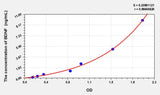
Le principe de test appliqué dans ce kit est un dosage immunoenzymatique de type sandwich. La plaque de microtitration fournie dans ce kit a été pré-enduite d'un anticorps spécifique au BDNF canin. Des étalons ou des échantillons sont ajoutés aux puits appropriés de la plaque de microtitration, puis un anticorps conjugué à la biotine spécifique au BDNF canin est ajouté. Ensuite, de l'avidine conjuguée à la peroxydase de raifort (HRP) est ajoutée à chaque puits de microplaque et incubée. Après l'ajout de la solution de substrat TMB, seuls les puits contenant le BDNF canin, l'anticorps conjugué à la biotine et l'avidine conjuguée à l'enzyme présenteront un changement de couleur. La réaction enzyme-substrat est interrompue par l'ajout d'une solution d'acide sulfurique et le changement de couleur est mesuré par spectrophotométrie à une longueur d'onde de 450 nm ± 10 nm. La concentration de BDNF canin dans les échantillons est ensuite déterminée en comparant la DO des échantillons à la courbe étalon.

Contexte de la cible

Les noms alternatifs incluent Neurotrophine ; Abrineurine.

Key facts & specifications
Research areas
Cytokine, Infection immunity, Neuro science
Also known as
Neurotrophine; Abrineurine
Capacity / size
48T
Assay type
Sandwich
Detection method
Colorimétrique (TMB/HRP)
Sensitivity
0,068 ng/mL
Detection range
0,16-10 ng/mL
Plate format
Plaque 96 puits pré-enduite
Form / buffer
Kit microplaque pré-revêtue
Quantity per pack
48T
Validation & performance evidence
ABMIUM Validated™ ABMIUM Verified™ Expected performance Not suitable

Sample type validation

Sample compatibility evidence using the same validation key.

Sample typeSérumPlasmaHomogénats tissulairesLysats cellulairesSurnageants de culture cellulaireAutres fluides biologiques
Compatibilité de l'échantillon
Identifiers & database references
Supplier SKU / catalogue number
ELK5417
UniProt entry
Q7YRB4
Storage, stability & shipping
Storage conditions
Stocker conformément aux conditions énoncées dans le manuel du produit.
Long-term storage
Stocker conformément aux conditions énoncées dans le manuel du produit.
Compliance & documents
CE marked
No
ISO certifications
ISO 9001
Product manual
Open manual
Frequently asked questions
Who manufactured this product?

This product is manufactured by ELK Biotechnology and sold through ABMIUM without relabelling.

Can ABMIUM ship this product internationally?

ABMIUM supports global orders. Availability, shipping requirements and applicable import arrangements are confirmed before fulfilment where required.

Can I check suitability before ordering?

Yes. Send your target, sample, application and experimental conditions through ABMIUM MATCH or technical support.

Is this product for clinical use?

Unless the listing expressly states otherwise, ABMIUM products are supplied for research use only and are not for diagnostic or therapeutic use.

Research target context

BDNFbrain derived neurotrophic factor

View target guide

Brain derived neurotrophic factor (BDNF) is a nerve growth factor-family signalling protein produced from a precursor form, proBDNF. Mature BDNF is a major neurotrophin studied for its roles in neuronal survival, differentiation and synaptic plasticity.

Biological function: BDNF activates signalling through the neurotrophin receptor NTRK2 (TrkB). It supports survival and differentiation of selected neuronal populations, contributes to axonal growth and pathfinding, regulates dendritic growth and morphology, and is a major modulator of synaptic transmission and plasticity.

Organism
Multiple species; representative: Homo sapiens (Human)
NCBI Gene
627
UniProtKB
P23560
ELK Biotechnology
£366.00