Primary Antibody supplied by Boster Bio
Know who made it. See the evidence. Buy through one marketplace.
Anti-Calreticulin/CALR Antibody Picoband® is a research-use antibody from Boster Bio for studying Calreticulin in ELISA, Flow Cytometry, IHC, IHC-P, WB workflows with listed reactivity for Human, Mouse, Rat. Specifications and supporting documents below should be reviewed when planning the experiment.
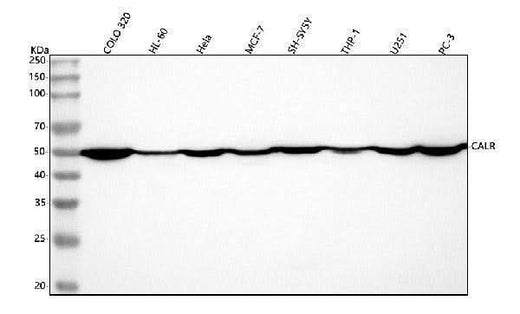
Boster Bio Anti-Calreticulin/CALR Antibody Picoband® catalog # A00894-2. Tested in ELISA, IHC, WB, Flow Cytometry applications. This antibody reacts with Human, Mouse, Rat. The brand Picoband indicates this is a premium antibody that guarantees superior quality, high affinity, and strong signals with minimal background in Western blot applications. Only our best-performing antibodies are designated as Picoband, ensuring unmatched performance.Calreticulin also known as calregulin, CRP55, CaBP3, calsequestrin-like protein, and endoplasmic reticulum resident protein 60 (ERp60) is a protein that in humans is encoded by the CALR gene. It is mapped to 19p13.13. Calreticulin is a multifunctional protein that acts as a major Ca(2+)-binding (storage) protein in the lumen of the endoplasmic reticulum. It is also found in the nucleus, suggesting that it may have a role in transcription regulation. Calreticulin binds to the synthetic peptide KLGFFKR, which is almost identical to an amino acid sequence in the DNA-binding domain of the superfamily of nuclear receptors. Calreticulin binds to antibodies in certain sera of systemic lupus and Sjogren patients which contain anti-Ro/SSA antibodies, it is highly conserved among species, and it is located in the endoplasmic and sarcoplasmic reticulum where it may bind calcium. The amino terminus of calreticulin interacts with the DNA-binding domain of the glucocorticoid receptor and prevents the receptor from binding to its specific glucocorticoid response element. Calreticulin can inhibit the binding of androgen receptor to its hormone-responsive DNA element and can inhibit androgen receptor and retinoic acid receptor transcriptional activities in vivo, as well as retinoic acid-induced neuronal differentiation. Thus, calreticulin can act as an important modulator of the regulation of gene transcription by nuclear hormone receptors. Systemic lupus erythematosus is associated with increased autoantibody titers against calreticulin but calreticulin is not a Ro/SS-A antigen. Earlier papers referred to calreticulin as an Ro/SS-A antigen but this was later disproven. Increased autoantibody titer against human calreticulin is found in infants with complete congenital heart block of both the IgG and IgM classes.
Fully tested in-house by ABMIUM. Highest confidence. Non-conformities fully supported under the ABMIUM Product Promise.
Quality verified. Independent collaborator or expected-performance data available. Product meets ABMIUM quality standards.
Expected to work based on structural and biochemical data. Not yet directly tested by ABMIUM or a collaborator. No non-conformity support for this combination.
Not recommended for this application or species/sample combination. This may indicate either evidence of unsuitability or that the combination has not been tested and therefore cannot currently be recommended.
Evidence status by application and model.
| Species | WB | IHC | IHC-P | IHC-F | IF/ICC | Flow Cytometry | ELISA | IP |
|---|---|---|---|---|---|---|---|---|
| Human | ||||||||
| Mouse | ||||||||
| Rat |
This product is manufactured by Boster Bio and sold through ABMIUM without relabelling.
ABMIUM supports global orders. Availability, shipping requirements and applicable import arrangements are confirmed before fulfilment where required.
Yes. Send your target, sample, application and experimental conditions through ABMIUM MATCH or technical support.
Unless the listing expressly states otherwise, ABMIUM products are supplied for research use only and are not for diagnostic or therapeutic use.