
MDM2 (Phospho-Tyr394) Rabbit pAb
MDM2 (Phospho-Tyr394) Rabbit pAb from ELK Biotechnology Read more ›

Product Description
MDM2 (Phospho-Tyr394) Rabbit pAb is an ELK Biotechnology antibody for research workflows involving MDM2.
Background
This gene encodes a nuclear-localized E3 ubiquitin ligase. The encoded protein can promote tumor formation by targeting tumor suppressor proteins, such as p53, for proteasomal degradation. This gene is itself transcriptionally-regulated by p53. Overexpression or amplification of this locus is detected in a variety of different cancers. There is a pseudogene for this gene on chromosome 2. Alternative splicing results in a multitude of transcript variants, many of which may be expressed only in tumor cells. [provided by RefSeq, Jun 2013],
Additional antibody information
| Specificity | The antibody detects endogenous MDM2 (Phospho-Tyr394) Antibody |
|---|---|
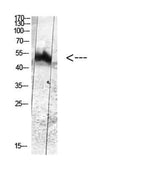
| Validation evidence captions | Western blot analysis of HELA-UV Cell Lysate using antibody |
Key Facts
| Target | MDM2 |
| Also known as | E3 ubiquitin-protein ligase Mdm2 (EC 6.3.2.-) (Double minute 2 protein) (Hdm2) (Oncoprotein Mdm2) (p53-binding protein Mdm2) |
| Concentration | 1 mg/ml |
| Working concentration | WB 1:500-2000, ELISA 1:10000-20000 |
| Species reactivity | Human;Mouse |
| Observed band | 42kD |
| Cellular localization | Nucleus, nucleoplasm. Cytoplasm . Nucleus, nucleolus. Nucleus . Expressed predominantly in the nucleoplasm. Interaction with ARF(P14) results in the localization of both proteins to the nucleolus. The nucleolar localization signals in both ARF(P14) and MDM2 may be necessary to allow efficient nucleolar localization of both proteins. Colocalizes with RASSF1 isoform A in the nucleus. |
| Purity | The antibody was affinity-purified from rabbit antiserum by affinity-chromatography using epitope-specific immunogen. |
| Form / buffer | Liquid in PBS containing 50% glycerol, 0.5% BSA and 0.02% sodium azide. |
| Research area | >>Endocrine resistance;>>Platinum drug resistance;>>FoxO signaling pathway;>>Cell cycle;>>p53 signaling pathway;>>Ubiquitin mediated proteolysis;>>Endocytosis;>>PI3K-Akt signaling pathway;>>Cellular senescence;>>C-type lectin receptor signaling pathway;>>Thyroid hormone signaling pathway;>>Shigellosis;>>Human cytomegalovirus infection;>>Human papillomavirus infection;>>Epstein-Barr virus infection;>>Pathways in cancer;>>Transcriptional misregulation in cancer;>>Viral carcinogenesis;>>Proteoglycans in cancer;>>MicroRNAs in cancer;>>Glioma;>>Prostate cancer;>>Melanoma;>>Bladder cancer;>>Chronic myeloid leukemia |
| Host species | Rabbit |
| Clonality | Polyclonal |
| Isotype | IgG |
| Conjugation | Unconjugated |
| Tested applications |
WBELISA |
| Dilution range | WB 1:500-2000, ELISA 1:10000-20000 |
| Immunogen | Synthesized phospho-peptide around the phosphorylation site of human MDM2 (Phospho-Tyr394) |
| Purification | The antibody was affinity-purified from rabbit antiserum by affinity-chromatography using epitope-specific immunogen. |
Reactivity & Application Validation
2 speciess| Species | WB | IHC | IF | ELISA | IP | FCM | CHIP |
|---|---|---|---|---|---|---|---|
| Human | |||||||
| Mouse |
| Species | Dilution | Notes |
|---|---|---|
| Human | WB 1:500-2000 | — |
| Mouse | — | — |
| Species | Dilution | Notes |
|---|
Specifications
Storage & Stability
Compliance & Certifications
Manufactured under ISO 9001:2015 quality management standards.
Not intended for diagnostic or therapeutic use.