
Cleaved-Caspase-4/5 p20 (D270/D311) rabbit pAb
Cleaved-Caspase-4/5 p20 (D270/D311) rabbit pAb from ELK Biotechnology Read more ›

Product Description
Cleaved-Caspase-4/5 p20 (D270/D311) rabbit pAb is an ELK Biotechnology antibody for research workflows involving Caspase-4/5.
Background
This gene encodes a protein that is a member of the cysteine-aspartic acid protease (caspase) family. Sequential activation of caspases plays a central role in the execution-phase of cell apoptosis. Caspases exist as inactive proenzymes composed of a prodomain and a large and small protease subunit. Activation of caspases requires proteolytic processing at conserved internal aspartic residues to generate a heterodimeric enzyme consisting of the large and small subunits. This caspase is able to cleave and activate its own precursor protein, as well as caspase 1 precursor. When overexpressed, this gene induces cell apoptosis. Alternative splicing results in transcript variants encoding distinct isoforms. [provided by RefSeq, Jul 2008],
Additional antibody information
| Specificity | Cleaved-Caspase-4/5 p20 (D270/D311) Polyclonal Antibody detects endogenous levels of fragment of activated Caspase-4/5 p20 protein resulting from cleavage adjacent to D270/D311. |
|---|---|
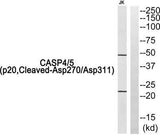
| Validation evidence captions | Western blot analysis of Caspase 4/5 (p20, Cleaved-Asp270/Asp311) Antibody. The lane on the right is blocked with the Caspase 4/5 (p20, Cleaved-Asp270/Asp311) peptide. |
Key Facts
| Target | Caspase-4/5 |
| Also known as | CASP4; ICH2; Caspase-4; CASP-4; ICE(rel)-II; Protease ICH-2; Protease TX; CASP5; ICH3; Caspase-5; CASP-5; ICE(rel)-III; Protease ICH-3; Protease TY |
| Concentration | 1 mg/ml |
| Working concentration | Western Blot: 1/500 - 1/2000. ELISA: 1/40000. Not yet tested in other applications. |
| Species reactivity | Human |
| Observed band | 47,22kD |
| Cellular localization | Cytoplasm, cytosol . Endoplasmic reticulum membrane ; Peripheral membrane protein ; Cytoplasmic side . Mitochondrion . Inflammasome . Secreted . Predominantly localizes to the endoplasmic reticulum (ER). Association with the ER membrane requires TMEM214 (PubMed:15123740). Released in the extracellular milieu by keratinocytes following UVB irradiation (PubMed:22246630). . |
| Purity | The antibody was affinity-purified from rabbit antiserum by affinity-chromatography using epitope-specific immunogen. |
| Form / buffer | Liquid in PBS containing 50% glycerol, 0.5% BSA and 0.02% sodium azide. |
| Research area | >>Neutrophil extracellular trap formation;>>NOD-like receptor signaling pathway;>>Pathogenic Escherichia coli infection;>>Shigellosis;>>Salmonella infection |
| Host species | Rabbit |
| Clonality | Polyclonal |
| Isotype | IgG |
| Conjugation | Unconjugated |
| Tested applications |
WBELISA |
| Dilution range | Western Blot: 1/500 - 1/2000. ELISA: 1/40000. Not yet tested in other applications. |
| Immunogen | The antiserum was produced against synthesized peptide derived from human Caspase 4/5. AA range:221-270 |
| Purification | The antibody was affinity-purified from rabbit antiserum by affinity-chromatography using epitope-specific immunogen. |
Reactivity & Application Validation
1 species| Species | WB | IHC | IF | ELISA | IP | FCM | CHIP |
|---|---|---|---|---|---|---|---|
| Human |
| Species | Dilution | Notes |
|---|---|---|
| Human | Western Blot: 1/500 - 1/2000. ELISA: 1/40000. Not yet tested in other applications. | — |
| Species | Dilution | Notes |
|---|
Specifications
Storage & Stability
Compliance & Certifications
Manufactured under ISO 9001:2015 quality management standards.
Not intended for diagnostic or therapeutic use.