
VCP (phospho Ser352) rabbit pAb from ELK Biotechnology Read more ›

VCP (phospho Ser352) rabbit pAb is a research-use antibody from ELK Biotechnology for studying VCP in WB, ELISA workflows with listed reactivity for Human, Mouse, Rat. Specifications and supporting documents below should be reviewed when planning the experiment.
valosin containing protein(VCP) Homo sapiens The protein encoded by this gene is a member of a family that includes putative ATP-binding proteins involved in vesicle transport and fusion, 26S proteasome function, and assembly of peroxisomes. This protein, as a structural protein, is associated with clathrin, and heat-shock protein Hsc70, to form a complex. It has been implicated in a number of cellular events that are regulated during mitosis, including homotypic membrane fusion, spindle pole body function, and ubiquitin-dependent protein degradation. [provided by RefSeq, Jul 2008],
| Specificity | Phospho-VCP (S352) Polyclonal Antibody detects endogenous levels of VCP protein only when phosphorylated at S352. |
|---|---|
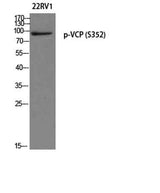
| Validation evidence captions | Western blot analysis of 22RV1 using p-VCP (S352) antibody. Antibody was diluted at 1:1000 | Western blot analysis of lysates from NIH/3T3 cells treated with starved 24h, using VCP (Phospho-Ser352) Antibody. The lane on the right is blocked with the phospho peptide. |
| Collaborator | ELK Biotechnology |
| Partner model | ES7491 |
| Target | VCP |
| Research areas | >>Protein processing in endoplasmic reticulum, >>Amyotrophic lateral sclerosis, >>Pathways of neurodegeneration - multiple diseases, >>Legionellosis |
| Reactivity | Human,Mouse,Rat |
| Applications | WB,ELISA |
| Conjugation | Unconjugated |
| Dilution range | Western Blot: 1/500 - 1/2000. ELISA: 1/5000. Not yet tested in other applications. |
| Host | Rabbit |
| Clonality | Polyclonal |
| Isotype | IgG |
| Immunogen | The antiserum was produced against synthesized peptide derived from human VCP around the phosphorylation site of Ser352. AA range:318-367 |
| Concentration | 1 mg/ml |
| Purification | The antibody was affinity-purified from rabbit antiserum by affinity-chromatography using epitope-specific immunogen. |
| Assay type | Antibody validation/application |
| Expression system | Brain,Epithelium,Fetal brain cortex,Kidney,Lymph,PCR rescued clones,Pituitary,Plate |
| Purity | The antibody was affinity-purified from rabbit antiserum by affinity-chromatography using epitope-specific immunogen. |
| Species | WB | IHC | IF | ELISA | IP | FCM | ChIP |
|---|---|---|---|---|---|---|---|
| Human | |||||||
| Mouse | |||||||
| Rat |
| Species | Dilution | Notes |
|---|---|---|
| Human | Western Blot: 1/500 - 1/2000. ELISA: 1/5000. Not yet tested in other applications. | — |
| Mouse | — | — |
| Rat | — | — |
| Species | Dilution | Notes |
|---|
Collaborator meets ABMIUM quality standards and overall product performance standards have been met.
Quality management certification.
For research applications. Not for diagnostic use.
No customer reviews yet.
