
BAI-1 rabbit pAb from ELK Biotechnology Read more ›

BAI-1 rabbit pAb is a research-use antibody from ELK Biotechnology for studying BAI-1 in WB, IHC, IF, ELISA workflows with listed reactivity for Human, Mouse. Specifications and supporting documents below should be reviewed when planning the experiment.
Angiogenesis is controlled by a local balance between stimulators and inhibitors of new vessel growth and is suppressed under normal physiologic conditions. Angiogenesis has been shown to be essential for growth and metastasis of solid tumors. In order to obtain blood supply for their growth, tumor cells are potently angiogenic and attract new vessels as results of increased secretion of inducers and decreased production of endogenous negative regulators. BAI1 contains at least one 'functional' p53-binding site within an intron, and its expression has been shown to be induced by wildtype p53. There are two other brain-specific angiogenesis inhibitor genes, designated BAI2 and BAI3 which along with BAI1 have similar tissue specificities and structures, however only BAI1 is transcriptionally regulated by p53. BAI1 is postulated to be a member of the secretin receptor family,
| Specificity | BAI-1 Polyclonal Antibody detects endogenous levels of BAI-1 protein. |
|---|---|
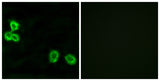
| Validation evidence captions | Immunofluorescence analysis of MCF7 cells, using BAI1 Antibody. The picture on the right is blocked with the synthesized peptide. | Immunohistochemistry analysis of paraffin-embedded human brain tissue, using BAI1 Antibody. The picture on the right is blocked with the synthesized peptide. | Western blot analysis of lysates from HepG2 cells, using BAI1 Antibody. The lane on the right is blocked with the synthesized peptide. | Western blot analysis of the lysates from HUVECcells using BAI1 antibody. |
| Collaborator | ELK Biotechnology |
| Partner model | ES6910 |
| Target | BAI-1 |
| Research areas | >>p53 signaling pathway |
| Reactivity | Human,Mouse |
| Applications | WB,IHC,IF,ELISA |
| Conjugation | Unconjugated |
| Dilution range | Western Blot: 1/500 - 1/2000. Immunohistochemistry: 1/100 - 1/300. Immunofluorescence: 1/200 - 1/1000. ELISA: 1/10000. Not yet tested in other applications. |
| Host | Rabbit |
| Clonality | Polyclonal |
| Isotype | IgG |
| Immunogen | The antiserum was produced against synthesized peptide derived from human BAI1. AA range:691-740 |
| Concentration | 1 mg/ml |
| Purification | The antibody was affinity-purified from rabbit antiserum by affinity-chromatography using epitope-specific immunogen. |
| Assay type | Antibody validation/application |
| Expression system | Expressed in brain (at protein level) (PubMed:12074842, PubMed:12507886). Expressed on mononuclear phagocytes and monocyte-derived macrophages in the gastric mucosa (at protein level) (PubMed:24509909). Expressed in normal pancreatic tissue but not in pancreatic tumor tissue (PubMed:11875720). Reduced or no expression is observed in some glioblastomas (PubMed:12507886). |
| Purity | The antibody was affinity-purified from rabbit antiserum by affinity-chromatography using epitope-specific immunogen. |
| Species | WB | IHC | IF | ELISA | IP | FCM | ChIP |
|---|---|---|---|---|---|---|---|
| Human | |||||||
| Mouse |
| Species | Dilution | Notes |
|---|---|---|
| Human | Western Blot: 1/500 - 1/2000. Immunohistochemistry: 1/100 - 1/300. Immunofluorescence: 1/200 - 1/1000. ELISA: 1/10000. Not yet tested in other applications. | — |
| Mouse | — | — |
| Species | Dilution | Notes |
|---|
| Species | Dilution | Notes |
|---|
| Species | Dilution | Notes |
|---|
Collaborator meets ABMIUM quality standards and overall product performance standards have been met.
Quality management certification.
For research applications. Not for diagnostic use.
No customer reviews yet.
