
KIR3.1 rabbit pAb
KIR3.1 rabbit pAb from ELK Biotechnology Read more ›

Product Description
KIR3.1 rabbit pAb is an ELK Biotechnology antibody for research workflows involving KIR3.1.
Background
Potassium channels are present in most mammalian cells, where they participate in a wide range of physiologic responses. The protein encoded by this gene is an integral membrane protein and inward-rectifier type potassium channel. The encoded protein, which has a greater tendency to allow potassium to flow into a cell rather than out of a cell, is controlled by G-proteins and plays an important role in regulating heartbeat. It associates with three other G-protein-activated potassium channels to form a heteromultimeric pore-forming complex that also couples to neurotransmitter receptors in the brain and whereby channel activation can inhibit action potential firing by hyperpolarizing the plasma membrane. These multimeric G-protein-gated inwardly-rectifying potassium (GIRK) channels may play a role in the pathophysiology of epilepsy, addiction, Down's syndrome, at
Additional antibody information
| Specificity | KIR3.1 Polyclonal Antibody detects endogenous levels of KIR3.1 protein. |
|---|---|
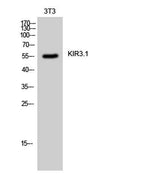
| Validation evidence captions | Western Blot analysis of 3T3 cells using KIR3.1 Polyclonal Antibody | Immunofluorescence analysis of HeLa cells, using GIRK1/KIR3.1/KCNJ3 Antibody. The picture on the right is blocked with the synthesized peptide. | Western blot analysis of lysates from NIH/3T3 cells, using GIRK1/KIR3.1/KCNJ3 Antibody. The lane on the right is blocked with the synthesized peptide. | Immunohistochemical analysis of paraffin-embedded human liver cancer. 1, Antibody was diluted at 1:200(4° overnight). 2, Tris-EDTA,pH9.0 was used for antigen retrieval. 3,Secondary antibody was diluted at 1:200(room temperature, 45min). |
Key Facts
| Target | KIR3.1 |
| Also known as | KCNJ3; GIRK1; G protein-activated inward rectifier potassium channel 1; GIRK-1; Inward rectifier K(+) channel Kir3.1; Potassium channel; inwardly rectifying subfamily J member 3 |
| Concentration | 1 mg/ml |
| Working concentration | WB 1:500-2000;IHC-p 1:50-300 |
| Species reactivity | Human;Mouse;Rat |
| Observed band | 56kD |
| Cellular localization | Membrane; Multi-pass membrane protein. |
| Purity | The antibody was affinity-purified from rabbit antiserum by affinity-chromatography using epitope-specific immunogen. |
| Form / buffer | Liquid in PBS containing 50% glycerol, 0.5% BSA and 0.02% sodium azide. |
| Research area | >>Circadian entrainment;>>Retrograde endocannabinoid signaling;>>Glutamatergic synapse;>>Cholinergic synapse;>>Serotonergic synapse;>>Dopaminergic synapse;>>Estrogen signaling pathway;>>Oxytocin signaling pathway;>>GnRH secretion;>>Morphine addiction |
| Host species | Rabbit |
| Clonality | Polyclonal |
| Isotype | IgG |
| Conjugation | Unconjugated |
| Tested applications |
WBIHC |
| Dilution range | WB 1:500-2000;IHC-p 1:50-300 |
| Immunogen | The antiserum was produced against synthesized peptide derived from human GIRK1/KIR3.1/KCNJ3. AA range:151-200 |
| Purification | The antibody was affinity-purified from rabbit antiserum by affinity-chromatography using epitope-specific immunogen. |
Reactivity & Application Validation
3 speciess| Species | WB | IHC | IF | ELISA | IP | FCM | CHIP |
|---|---|---|---|---|---|---|---|
| Human | |||||||
| Mouse | |||||||
| Rat |
| Species | Dilution | Notes |
|---|---|---|
| Human | WB 1:500-2000;IHC-p 1:50-300 | — |
| Mouse | — | — |
| Rat | — | — |
| Species | Dilution | Notes |
|---|
Specifications
Storage & Stability
Compliance & Certifications
Manufactured under ISO 9001:2015 quality management standards.
Not intended for diagnostic or therapeutic use.