
Kv1.3 (phospho Tyr187) rabbit pAb
Kv1.3 (phospho Tyr187) rabbit pAb from ELK Biotechnology Read more ›

Product Description
Kv1.3 (phospho Tyr187) rabbit pAb is an ELK Biotechnology antibody for research workflows involving Kv1.3.
Background
Potassium channels represent the most complex class of voltage-gated ion channels from both functional and structural standpoints. Their diverse functions include regulating neurotransmitter release, heart rate, insulin secretion, neuronal excitability, epithelial electrolyte transport, smooth muscle contraction, and cell volume. Four sequence-related potassium channel genes - shaker, shaw, shab, and shal - have been identified in Drosophila, and each has been shown to have human homolog(s). This gene encodes a member of the potassium channel, voltage-gated, shaker-related subfamily. This member contains six membrane-spanning domains with a shaker-type repeat in the fourth segment. It belongs to the delayed rectifier class, members of which allow nerve cells to efficiently repolarize following an action potential. It plays an essential role in T-cell proliferation and
Additional antibody information
| Specificity | Phospho-Kv1.3 (Y187) Polyclonal Antibody detects endogenous levels of Kv1.3 protein only when phosphorylated at Y187. |
|---|---|
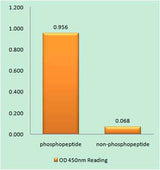
| Validation evidence captions | Enzyme-Linked Immunosorbent Assay (Phospho-ELISA) for Immunogen Phosphopeptide (Phospho-left) and Non-Phosphopeptide (Phospho-right), using Kv1.3/KCNA3 (Phospho-Tyr135) Antibody | Immunofluorescence analysis of HUVEC cells, using Kv1.3/KCNA3 (Phospho-Tyr135) Antibody. The picture on the right is blocked with the phospho peptide. | Immunohistochemistry analysis of paraffin-embedded human brain, using Kv1.3/KCNA3 (Phospho-Tyr135) Antibody. The picture on the right is blocked with the phospho peptide. | Western blot analysis of lysates from Jurkat cells treated with starved 24h, using Kv1.3/KCNA3 (Phospho-Tyr135) Antibody. The lane on the right is blocked with the phospho peptide. |
Key Facts
| Target | Kv1.3 |
| Also known as | KCNA3; HGK5; Potassium voltage-gated channel subfamily A member 3; HGK5; HLK3; HPCN3; Voltage-gated K(+) channel HuKIII; Voltage-gated potassium channel subunit Kv1.3 |
| Concentration | 1 mg/ml |
| Working concentration | Western Blot: 1/500 - 1/2000. Immunohistochemistry: 1/100 - 1/300. Immunofluorescence: 1/200 - 1/1000. ELISA: 1/20000. Not yet tested in other applications. |
| Species reactivity | Human;Mouse;Rat |
| Observed band | 58kD |
| Cellular localization | Cell membrane ; Multi-pass membrane protein. |
| Purity | The antibody was affinity-purified from rabbit antiserum by affinity-chromatography using epitope-specific immunogen. |
| Form / buffer | Liquid in PBS containing 50% glycerol, 0.5% BSA and 0.02% sodium azide. |
| Research area | Antibody Research |
| Host species | Rabbit |
| Clonality | Polyclonal |
| Isotype | IgG |
| Conjugation | Unconjugated |
| Tested applications |
WBIHCIFELISA |
| Dilution range | Western Blot: 1/500 - 1/2000. Immunohistochemistry: 1/100 - 1/300. Immunofluorescence: 1/200 - 1/1000. ELISA: 1/20000. Not yet tested in other applications. |
| Immunogen | The antiserum was produced against synthesized peptide derived from human Kv1.3/KCNA3 around the phosphorylation site of Tyr135. AA range:101-150 |
| Purification | The antibody was affinity-purified from rabbit antiserum by affinity-chromatography using epitope-specific immunogen. |
Reactivity & Application Validation
3 speciess| Species | WB | IHC | IF | ELISA | IP | FCM | CHIP |
|---|---|---|---|---|---|---|---|
| Human | |||||||
| Mouse | |||||||
| Rat |
| Species | Dilution | Notes |
|---|---|---|
| Human | Western Blot: 1/500 - 1/2000. Immunohistochemistry: 1/100 - 1/300. Immunofluorescence: 1/200 - 1/1000. ELISA: 1/20000. Not yet tested in other applications. | — |
| Mouse | — | — |
| Rat | — | — |
| Species | Dilution | Notes |
|---|
| Species | Dilution | Notes |
|---|
| Species | Dilution | Notes |
|---|
Specifications
Storage & Stability
Compliance & Certifications
Manufactured under ISO 9001:2015 quality management standards.
Not intended for diagnostic or therapeutic use.