
IRF-3 (phospho Ser396) rabbit pAb
IRF-3 (phospho Ser396) rabbit pAb from ELK Biotechnology Read more ›

Product Description
IRF-3 (phospho Ser396) rabbit pAb is an ELK Biotechnology antibody for research workflows involving IRF-3.
Background
This gene encodes a member of the interferon regulatory transcription factor (IRF) family. The encoded protein is found in an inactive cytoplasmic form that upon serine/threonine phosphorylation forms a complex with CREBBP. This complex translocates to the nucleus and activates the transcription of interferons alpha and beta, as well as other interferon-induced genes. Alternatively spliced transcript variants encoding multiple isoforms have been observed for this gene. [provided by RefSeq, Nov 2011],
Additional antibody information
| Specificity | Phospho-IRF-3 (S396) Polyclonal Antibody detects endogenous levels of IRF-3 protein only when phosphorylated at S396. |
|---|---|
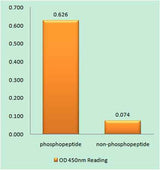
| Validation evidence captions | Enzyme-Linked Immunosorbent Assay (Phospho-ELISA) for Immunogen Phosphopeptide (Phospho-left) and Non-Phosphopeptide (Phospho-right), using IRF-3 (Phospho-Ser396) Antibody | Western blot analysis of lysates from Jurkat cells treated with EGF 200ng/ml 30', using IRF-3 (Phospho-Ser396) Antibody. The lane on the right is blocked with the phospho peptide. | Immunohistochemical analysis of paraffin-embedded human liver cancer. 1, Antibody was diluted at 1:200(4° overnight). 2, Tris-EDTA,pH9.0 was used for antigen retrieval. 3,Secondary antibody was diluted at 1:200(room temperature, 45min). |
Key Facts
| Target | IRF-3 |
| Also known as | IRF3; Interferon regulatory factor 3; IRF-3 |
| Concentration | 1 mg/ml |
| Working concentration | WB 1:500-2000;IHC-p 1:50-300 |
| Species reactivity | Human;Mouse;Rat |
| Observed band | 48-55kd |
| Cellular localization | Cytoplasm . Nucleus . Mitochondrion . Shuttles between cytoplasmic and nuclear compartments, with export being the prevailing effect (PubMed:10805757). When activated, IRF3 interaction with CREBBP prevents its export to the cytoplasm (PubMed:10805757). Recruited to mitochondria via TOMM70:HSP90AA1 upon Sendai virus infection (PubMed:25609812). . |
| Purity | The antibody was affinity-purified from rabbit antiserum by affinity-chromatography using epitope-specific immunogen. |
| Form / buffer | Liquid in PBS containing 50% glycerol, 0.5% BSA and 0.02% sodium azide. |
| Research area | >>Toll-like receptor signaling pathway;>>NOD-like receptor signaling pathway;>>RIG-I-like receptor signaling pathway;>>Cytosolic DNA-sensing pathway;>>Alcoholic liver disease;>>Shigellosis;>>Pertussis;>>Yersinia infection;>>Hepatitis C;>>Hepatitis B;>>Measles;>>Human cytomegalovirus infection;>>Influenza A;>>Human papillomavirus infection;>>Kaposi sarcoma-associated herpesvirus infection;>>Herpes simplex virus 1 infection;>>Epstein-Barr virus infection;>>Human immunodeficiency virus 1 infection;>>Coronavirus disease - COVID-19;>>Viral carcinogenesis;>>Lipid and atherosclerosis |
| Host species | Rabbit |
| Clonality | Polyclonal |
| Isotype | IgG |
| Conjugation | Unconjugated |
| Tested applications |
WBIHC |
| Dilution range | WB 1:500-2000;IHC-p 1:50-300 |
| Immunogen | The antiserum was produced against synthesized peptide derived from human IRF-3 around the phosphorylation site of Ser396. AA range:362-411 |
| Purification | The antibody was affinity-purified from rabbit antiserum by affinity-chromatography using epitope-specific immunogen. |
Reactivity & Application Validation
3 speciess| Species | WB | IHC | IF | ELISA | IP | FCM | CHIP |
|---|---|---|---|---|---|---|---|
| Human | |||||||
| Mouse | |||||||
| Rat |
| Species | Dilution | Notes |
|---|---|---|
| Human | WB 1:500-2000;IHC-p 1:50-300 | — |
| Mouse | — | — |
| Rat | — | — |
| Species | Dilution | Notes |
|---|
Specifications
Storage & Stability
Compliance & Certifications
Manufactured under ISO 9001:2015 quality management standards.
Not intended for diagnostic or therapeutic use.