
GLI-3 rabbit pAb
GLI-3 rabbit pAb from ELK Biotechnology Read more ›

Product Description
GLI-3 rabbit pAb is an ELK Biotechnology antibody for research workflows involving GLI-3.
Background
This gene encodes a protein which belongs to the C2H2-type zinc finger proteins subclass of the Gli family. They are characterized as DNA-binding transcription factors and are mediators of Sonic hedgehog (Shh) signaling. The protein encoded by this gene localizes in the cytoplasm and activates patched Drosophila homolog (PTCH) gene expression. It is also thought to play a role during embryogenesis. Mutations in this gene have been associated with several diseases, including Greig cephalopolysyndactyly syndrome, Pallister-Hall syndrome, preaxial polydactyly type IV, and postaxial polydactyly types A1 and B. [provided by RefSeq, Jul 2008],
Additional antibody information
| Specificity | GLI-3 Polyclonal Antibody detects endogenous levels of GLI-3 protein. |
|---|---|
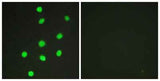
| Validation evidence captions | Immunofluorescence analysis of HepG2 cells, using GLI-3 Antibody. The picture on the right is blocked with the synthesized peptide. | Immunohistochemistry analysis of paraffin-embedded human brain tissue, using GLI-3 Antibody. The picture on the right is blocked with the synthesized peptide. |
Key Facts
| Target | GLI-3 |
| Also known as | GLI3; Transcriptional activator GLI3; GLI3 form of 190 kDa; GLI3-190; GLI3 full length protein; GLI3FL |
| Concentration | 1 mg/ml |
| Working concentration | Immunohistochemistry: 1/100 - 1/300. Immunofluorescence: 1/200 - 1/1000. ELISA: 1/10000. Not yet tested in other applications. |
| Species reactivity | Human;Mouse;Rat |
| Cellular localization | Nucleus. Cytoplasm. Cell projection, cilium. GLI3FL is localized predominantly in the cytoplasm while GLI3R resides mainly in the nucleus. Ciliary accumulation requires the presence of KIF7 and SMO. Translocation to the nucleus is promoted by interaction with ZIC1. |
| Purity | The antibody was affinity-purified from rabbit antiserum by affinity-chromatography using epitope-specific immunogen. |
| Form / buffer | Liquid in PBS containing 50% glycerol, 0.5% BSA and 0.02% sodium azide. |
| Research area | >>cAMP signaling pathway;>>Hedgehog signaling pathway;>>Pathways in cancer;>>Basal cell carcinoma |
| Host species | Rabbit |
| Clonality | Polyclonal |
| Isotype | IgG |
| Conjugation | Unconjugated |
| Tested applications |
IHCIFELISA |
| Dilution range | Immunohistochemistry: 1/100 - 1/300. Immunofluorescence: 1/200 - 1/1000. ELISA: 1/10000. Not yet tested in other applications. |
| Immunogen | The antiserum was produced against synthesized peptide derived from human GLI-3. AA range:11-60 |
| Purification | The antibody was affinity-purified from rabbit antiserum by affinity-chromatography using epitope-specific immunogen. |
Reactivity & Application Validation
3 speciess| Species | WB | IHC | IF | ELISA | IP | FCM | CHIP |
|---|---|---|---|---|---|---|---|
| Human | |||||||
| Mouse | |||||||
| Rat |
| Species | Dilution | Notes |
|---|---|---|
| Human | Immunohistochemistry: 1/100 - 1/300. Immunofluorescence: 1/200 - 1/1000. ELISA: 1/10000. Not yet tested in other applications. | — |
| Mouse | — | — |
| Rat | — | — |
| Species | Dilution | Notes |
|---|
| Species | Dilution | Notes |
|---|
Specifications
Storage & Stability
Compliance & Certifications
Manufactured under ISO 9001:2015 quality management standards.
Not intended for diagnostic or therapeutic use.