
Crk II rabbit pAb
Crk II rabbit pAb from ELK Biotechnology Read more ›

Product Description
Crk II rabbit pAb is an ELK Biotechnology antibody for research workflows involving Crk II.
Background
This gene encodes a member of an adapter protein family that binds to several tyrosine-phosphorylated proteins. The product of this gene has several SH2 and SH3 domains (src-homology domains) and is involved in several signaling pathways, recruiting cytoplasmic proteins in the vicinity of tyrosine kinase through SH2-phosphotyrosine interaction. The N-terminal SH2 domain of this protein functions as a positive regulator of transformation whereas the C-terminal SH3 domain functions as a negative regulator of transformation. Two alternative transcripts encoding different isoforms with distinct biological activity have been described. [provided by RefSeq, Jul 2008],
Additional antibody information
| Specificity | Crk II Polyclonal Antibody detects endogenous levels of Crk II protein. |
|---|---|
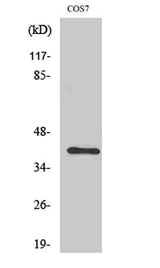
| Validation evidence captions | Western Blot analysis of various cells using Crk II Polyclonal Antibody | Immunofluorescence analysis of HUVEC cells, using CrkII Antibody. The picture on the right is blocked with the synthesized peptide. | Immunohistochemistry analysis of paraffin-embedded human lung carcinoma tissue, using CrkII Antibody. The picture on the right is blocked with the synthesized peptide. | Western blot analysis of lysates from COS7 cells, using CrkII Antibody. The lane on the right is blocked with the synthesized peptide. |
Key Facts
| Target | Crk II |
| Also known as | CRK; Adapter molecule crk; Proto-oncogene c-Crk; p38 |
| Concentration | 1 mg/ml |
| Working concentration | Western Blot: 1/500 - 1/2000. Immunohistochemistry: 1/100 - 1/300. Immunofluorescence: 1/200 - 1/1000. ELISA: 1/5000. Not yet tested in other applications. |
| Species reactivity | Human;Mouse;Rat;Monkey |
| Observed band | 40kD |
| Cellular localization | Cytoplasm . Cell membrane . Translocated to the plasma membrane upon cell adhesion. . |
| Purity | The antibody was affinity-purified from rabbit antiserum by affinity-chromatography using epitope-specific immunogen. |
| Form / buffer | Liquid in PBS containing 50% glycerol, 0.5% BSA and 0.02% sodium azide. |
| Research area | >>MAPK signaling pathway;>>ErbB signaling pathway;>>Rap1 signaling pathway;>>Chemokine signaling pathway;>>Focal adhesion;>>Fc gamma R-mediated phagocytosis;>>Neurotrophin signaling pathway;>>Regulation of actin cytoskeleton;>>Insulin signaling pathway;>>Growth hormone synthesis, secretion and action;>>Bacterial invasion of epithelial cells;>>Shigellosis;>>Yersinia infection;>>Human cytomegalovirus infection;>>Human immunodeficiency virus 1 infection;>>Pathways in cancer;>>MicroRNAs in cancer;>>Renal cell carcinoma;>>Chronic myeloid leukemia |
| Host species | Rabbit |
| Clonality | Polyclonal |
| Isotype | IgG |
| Conjugation | Unconjugated |
| Tested applications |
WBIHCIFELISA |
| Dilution range | Western Blot: 1/500 - 1/2000. Immunohistochemistry: 1/100 - 1/300. Immunofluorescence: 1/200 - 1/1000. ELISA: 1/5000. Not yet tested in other applications. |
| Immunogen | The antiserum was produced against synthesized peptide derived from human CrkII. AA range:187-236 |
| Purification | The antibody was affinity-purified from rabbit antiserum by affinity-chromatography using epitope-specific immunogen. |
Reactivity & Application Validation
4 speciess| Species | WB | IHC | IF | ELISA | IP | FCM | CHIP |
|---|---|---|---|---|---|---|---|
| Human | |||||||
| Mouse | |||||||
| Rat | |||||||
| Monkey |
| Species | Dilution | Notes |
|---|---|---|
| Human | Western Blot: 1/500 - 1/2000. Immunohistochemistry: 1/100 - 1/300. Immunofluorescence: 1/200 - 1/1000. ELISA: 1/5000. Not yet tested in other applications. | — |
| Mouse | — | — |
| Rat | — | — |
| Monkey | — | — |
| Species | Dilution | Notes |
|---|
| Species | Dilution | Notes |
|---|
| Species | Dilution | Notes |
|---|
Specifications
Storage & Stability
Compliance & Certifications
Manufactured under ISO 9001:2015 quality management standards.
Not intended for diagnostic or therapeutic use.