
CEP290 rabbit pAb
CEP290 rabbit pAb from ELK Biotechnology Read more ›

Product Description
CEP290 rabbit pAb is an ELK Biotechnology antibody for research workflows involving CEP290.
Background
centrosomal protein 290(CEP290) Homo sapiens This gene encodes a protein with 13 putative coiled-coil domains, a region with homology to SMC chromosome segregation ATPases, six KID motifs, three tropomyosin homology domains and an ATP/GTP binding site motif A. The protein is localized to the centrosome and cilia and has sites for N-glycosylation, tyrosine sulfation, phosphorylation, N-myristoylation, and amidation. Mutations in this gene have been associated with Joubert syndrome and nephronophthisis and the presence of antibodies against this protein is associated with several forms of cancer. [provided by RefSeq, Jul 2008],
Additional antibody information
| Specificity | CEP290 Polyclonal Antibody detects endogenous levels of CEP290 protein. |
|---|---|
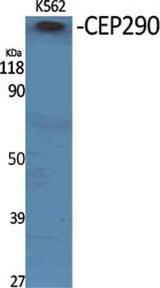
| Validation evidence captions | Western Blot analysis of various cells using CEP290 Polyclonal Antibody | Western blot analysis of lysates from K562 cells, using CEP290 Antibody. The lane on the right is blocked with the synthesized peptide. |
Key Facts
| Target | CEP290 |
| Also known as | CEP290; BBS14; KIAA0373; NPHP6; Centrosomal protein of 290 kDa; Cep290; Bardet-Biedl syndrome 14 protein; Cancer/testis antigen 87; CT87; Nephrocystin-6; Tumor antigen se2-2 |
| Concentration | 1 mg/ml |
| Working concentration | Western Blot: 1/500 - 1/2000. ELISA: 1/20000. Not yet tested in other applications. |
| Species reactivity | Human;Mouse |
| Observed band | 290kD |
| Cellular localization | Cytoplasm, cytoskeleton, microtubule organizing center, centrosome . Cytoplasm, cytoskeleton, microtubule organizing center, centrosome, centriolar satellite . Nucleus . Cell projection, cilium . Cytoplasm, cytoskeleton, cilium basal body . Cytoplasm, cytoskeleton, microtubule organizing center, centrosome, centriole . Cytoplasmic vesicle . Displaced from centriolar satellites in response to cellular stress, such as ultraviolet light (UV) radiation or heat shock (PubMed:24121310). Found in the connecting cilium of photoreceptor cells, base of cilium in kidney intramedullary collecting duct cells (By similarity). Localizes at the transition zone, a region between the basal body and the ciliary axoneme (PubMed:23943788). Localization at the ciliary transition zone as well as at centriolar sa |
| Purity | The antibody was affinity-purified from rabbit antiserum by affinity-chromatography using epitope-specific immunogen. |
| Form / buffer | Liquid in PBS containing 50% glycerol, 0.5% BSA and 0.02% sodium azide. |
| Research area | Antibody Research |
| Host species | Rabbit |
| Clonality | Polyclonal |
| Isotype | IgG |
| Conjugation | Unconjugated |
| Tested applications |
WBELISA |
| Dilution range | Western Blot: 1/500 - 1/2000. ELISA: 1/20000. Not yet tested in other applications. |
| Immunogen | The antiserum was produced against synthesized peptide derived from human CEP290. AA range:771-820 |
| Purification | The antibody was affinity-purified from rabbit antiserum by affinity-chromatography using epitope-specific immunogen. |
Reactivity & Application Validation
2 speciess| Species | WB | IHC | IF | ELISA | IP | FCM | CHIP |
|---|---|---|---|---|---|---|---|
| Human | |||||||
| Mouse |
| Species | Dilution | Notes |
|---|---|---|
| Human | Western Blot: 1/500 - 1/2000. ELISA: 1/20000. Not yet tested in other applications. | — |
| Mouse | — | — |
| Species | Dilution | Notes |
|---|
Specifications
Storage & Stability
Compliance & Certifications
Manufactured under ISO 9001:2015 quality management standards.
Not intended for diagnostic or therapeutic use.