
Smad2 (phospho Ser467) rabbit pAb from ELK Biotechnology Read more ›

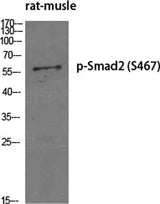
Smad2 (phospho Ser467) rabbit pAb is a research-use antibody from ELK Biotechnology for studying Smad2 in WB, IHC, IF, ELISA workflows with listed reactivity for Human, Mouse, Rat. Specifications and supporting documents below should be reviewed when planning the experiment.
The protein encoded by this gene belongs to the SMAD, a family of proteins similar to the gene products of the Drosophila gene 'mothers against decapentaplegic' (Mad) and the C. elegans gene Sma. SMAD proteins are signal transducers and transcriptional modulators that mediate multiple signaling pathways. This protein mediates the signal of the transforming growth factor (TGF)-beta, and thus regulates multiple cellular processes, such as cell proliferation, apoptosis, and differentiation. This protein is recruited to the TGF-beta receptors through its interaction with the SMAD anchor for receptor activation (SARA) protein. In response to TGF-beta signal, this protein is phosphorylated by the TGF-beta receptors. The phosphorylation induces the dissociation of this protein with SARA and the association with the family member SMAD4. The association with SMAD4 is important for the translocation
| Specificity | Phospho-Smad2 (S467) Polyclonal Antibody detects endogenous levels of Smad2 protein only when phosphorylated at S467. |
|---|---|
| Validation evidence captions | Western Blot analysis of various cells using Phospho-Smad2 (S467) Polyclonal Antibody diluted at 1:500 | Western Blot analysis of HepG2 cells using Phospho-Smad2 (S467) Polyclonal Antibody diluted at 1:500 | Enzyme-Linked Immunosorbent Assay (Phospho-ELISA) for Immunogen Phosphopeptide (Phospho-left) and Non-Phosphopeptide (Phospho-right), using Smad2 (Phospho-Ser467) Antibody | Immunohistochemistry analysis of paraffin-embedded human breast carcinoma, using Smad2 (Phospho-Ser467) Antibody. The picture on the right is blocked with the phospho peptide. |
| Collaborator | ELK Biotechnology |
| Partner model | ES1458 |
| Target | Smad2 |
| Research areas | >>Cell cycle, >>Endocytosis, >>Cellular senescence, >>TGF-beta signaling pathway, >>Apelin signaling pathway, >>Hippo signaling pathway, >>Signaling pathways regulating pluripotency of stem cells, >>Th17 cell differentiation, >>Relaxin signaling pathway, >>AGE-RAGE signaling pathway in diabetic complications, >>Chagas disease, >>Human T-cell leukemia virus 1 infection, >>Pathways in cancer, >>Proteoglycans in cancer, >>Colorectal cancer, >>Pancreatic cancer, >>Hepatocellular carcinoma, >>Gastric cancer, >>Inflammatory bowel disease, >>Diabetic cardiomyopathy |
| Reactivity | Human,Mouse,Rat |
| Applications | WB,IHC,IF,ELISA |
| Conjugation | Unconjugated |
| Dilution range | Western Blot: 1/500 - 1/2000. Immunohistochemistry: 1/100 - 1/300. ELISA: 1/5000. Not yet tested in other applications. |
| Host | Rabbit |
| Clonality | Polyclonal |
| Isotype | IgG |
| Immunogen | The antiserum was produced against synthesized peptide derived from human Smad2 around the phosphorylation site of Ser467. AA range:418-467 |
| Concentration | 1 mg/ml |
| Purification | The antibody was affinity-purified from rabbit antiserum by affinity-chromatography using epitope-specific immunogen. |
| Assay type | Antibody validation/application |
| Expression system | Expressed at high levels in skeletal muscle, endothelial cells, heart and placenta. |
| Purity | The antibody was affinity-purified from rabbit antiserum by affinity-chromatography using epitope-specific immunogen. |
| Species | WB | IHC | IF | ELISA | IP | FCM | ChIP |
|---|---|---|---|---|---|---|---|
| Human | |||||||
| Mouse | |||||||
| Rat |
| Species | Dilution | Notes |
|---|---|---|
| Human | Western Blot: 1/500 - 1/2000. Immunohistochemistry: 1/100 - 1/300. ELISA: 1/5000. Not yet tested in other applications. | — |
| Mouse | — | — |
| Rat | — | — |
| Species | Dilution | Notes |
|---|
| Species | Dilution | Notes |
|---|
| Species | Dilution | Notes |
|---|
Collaborator meets ABMIUM quality standards and overall product performance standards have been met.
Quality management certification.
For research applications. Not for diagnostic use.
No customer reviews yet.
