
p53 (phospho Thr18) rabbit pAb
p53 (phospho Thr18) rabbit pAb from ELK Biotechnology Read more ›

Product Description
p53 (phospho Thr18) rabbit pAb is an ELK Biotechnology antibody for research workflows involving p53.
Background
tumor protein p53(TP53) Homo sapiens This gene encodes a tumor suppressor protein containing transcriptional activation, DNA binding, and oligomerization domains. The encoded protein responds to diverse cellular stresses to regulate expression of target genes, thereby inducing cell cycle arrest, apoptosis, senescence, DNA repair, or changes in metabolism. Mutations in this gene are associated with a variety of human cancers, including hereditary cancers such as Li-Fraumeni syndrome. Alternative splicing of this gene and the use of alternate promoters result in multiple transcript variants and isoforms. Additional isoforms have also been shown to result from the use of alternate translation initiation codons (PMIDs: 12032546, 20937277). [provided by RefSeq, Feb 2013],
Additional antibody information
| Specificity | Phospho-p53 (T18) Polyclonal Antibody detects endogenous levels of p53 protein only when phosphorylated at T18. |
|---|---|
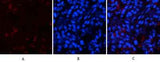
| Validation evidence captions | Immunofluorescence analysis of rat-lung tissue. 1,p53 (phospho Thr18) Polyclonal Antibody(red) was diluted at 1:200(4°C,overnight). 2, Cy3 labled Secondary antibody was diluted at 1:300(room temperature, 50min).3, Picture B: DAPI(blue) 10min. Picture A:Target. Picture B: DAPI. Picture C: merge of A+B | Immunofluorescence analysis of rat-lung tissue. 1,p53 (phospho Thr18) Polyclonal Antibody(red) was diluted at 1:200(4°C,overnight). 2, Cy3 labled Secondary antibody was diluted at 1:300(room temperature, 50min).3, Picture B: DAPI(blue) 10min. Picture A:Target. Picture B: DAPI. Picture C: merge of A+B | Immunohistochemical analysis of paraffin-embedded Human-lung-cancer tissue. 1,p53 (phospho Thr18) Polyclonal Antibody was diluted at 1:200(4°C,overnight). 2, Sodium citrate pH 6.0 was used for antibody retrieval(>98°C,20min). 3,Secondary antibody was diluted at 1:200(room tempeRature, 30min). Negative control was used by secondary antibody only. | Western Blot analysis of various cells using Phospho-p53 (T18) Polyclonal Antibody diluted at 1:2000 |
Key Facts
| Target | p53 |
| Also known as | TP53; P53; Cellular tumor antigen p53; Antigen NY-CO-13; Phosphoprotein p53; Tumor suppressor p53 |
| Concentration | 1 mg/ml |
| Working concentration | IF: 1:50-200 WB 1:500-2000, IHC 1:50-300 IHC 1:50-300 |
| Species reactivity | Human;Mouse;Rat |
| Observed band | 46kD |
| Cellular localization | Cytoplasm . Nucleus . Nucleus, PML body . Endoplasmic reticulum . Mitochondrion matrix . Cytoplasm, cytoskeleton, microtubule organizing center, centrosome . Recruited into PML bodies together with CHEK2 (PubMed:12810724). Translocates to mitochondria upon oxidative stress (PubMed:22726440). Translocates to mitochondria in response to mitomycin C treatment (PubMed:27323408). .; Isoform 1: Nucleus . Cytoplasm. Predominantly nuclear but localizes to the cytoplasm when expressed with isoform 4.; Isoform 2: Nucleus. Cytoplasm. Localized mainly in the nucleus with minor staining in the cytoplasm.; Isoform 3: Nucleus. Cytoplasm. Localized in the nucleus in most cells but found in the cytoplasm in some cells.; Isoform 4: Nucleus. Cytoplasm. Predominantly nuclear but translocates to the cy |
| Purity | The antibody was affinity-purified from rabbit antiserum by affinity-chromatography using epitope-specific immunogen. |
| Form / buffer | Liquid in PBS containing 50% glycerol, 0.5% BSA and 0.02% sodium azide. |
| Research area | >>Endocrine resistance;>>Platinum drug resistance;>>MAPK signaling pathway;>>Sphingolipid signaling pathway;>>Cell cycle;>>p53 signaling pathway;>>Mitophagy - animal;>>PI3K-Akt signaling pathway;>>Apoptosis;>>Longevity regulating pathway;>>Ferroptosis;>>Cellular senescence;>>Wnt signaling pathway;>>Neurotrophin signaling pathway;>>Thyroid hormone signaling pathway;>>Parkinson disease;>>Amyotrophic lateral sclerosis;>>Huntington disease;>>Shigellosis;>>Hepatitis C;>>Hepatitis B;>>Measles;>>Human cytomegalovirus infection;>>Human papillomavirus infection;>>Human T-cell leukemia virus 1 infection;>>Kaposi sarcoma-associated herpesvirus infection;>>Herpes simplex virus 1 infection;>>Epstein-Barr virus infection;>>Pathways in cancer;>>Transcriptional misregulation in cancer;>>Viral carcinogenesis;>>Proteoglycans in cancer;>>MicroRNAs in cancer;>>Colorectal cancer;>>Pancreatic cancer;>>Endometrial cancer;>>Glioma;>>Prostate cancer;>>Thyroid cancer;>>Basal cell carcinoma;>>Melanoma;>>Bladder |
| Host species | Rabbit |
| Clonality | Polyclonal |
| Isotype | IgG |
| Conjugation | Unconjugated |
| Tested applications |
WBIHCIFELISA |
| Dilution range | IF: 1:50-200 WB 1:500-2000, IHC 1:50-300 IHC 1:50-300 |
| Immunogen | The antiserum was produced against synthesized peptide derived from human p53 around the phosphorylation site of Thr18. AA range:1-50 |
| Purification | The antibody was affinity-purified from rabbit antiserum by affinity-chromatography using epitope-specific immunogen. |
Reactivity & Application Validation
3 speciess| Species | WB | IHC | IF | ELISA | IP | FCM | CHIP |
|---|---|---|---|---|---|---|---|
| Human | |||||||
| Mouse | |||||||
| Rat |
| Species | Dilution | Notes |
|---|---|---|
| Human | IF: 1:50-200 WB 1:500-2000 | — |
| Mouse | — | — |
| Rat | — | — |
| Species | Dilution | Notes |
|---|
| Species | Dilution | Notes |
|---|
| Species | Dilution | Notes |
|---|
Specifications
Storage & Stability
Compliance & Certifications
Manufactured under ISO 9001:2015 quality management standards.
Not intended for diagnostic or therapeutic use.