
MEK4 (F194)Rabbit pAb
MEK4 (F194)Rabbit pAb from ELK Biotechnology Read more ›

Product Description
MEK4 (F194)Rabbit pAb is an ELK Biotechnology antibody for research workflows involving MEK4 (F194)Rabbit pAb.
Background
SAPK/Erk kinase (SEK1), also known as MEK4 or MKK4 or Jun kinase kinase (JNKK), activates the MAP kinase homologues SAPK and JNK in response to various cellular stresses and inflammatory cytokines . Activation of SEK1 occurs through MEKK phosphorylation of serine and threonine residues at positions 257 and 261, respectively. Like MEK, SEK is a dual-specificity protein kinase that phosphorylates SAPK/JNK at a conserved T*PY* site in its activation loop . Phosphorylation by Akt at Ser80 inhibits SEK1 and suppresses stress-activated signal transduction .
Additional antibody information
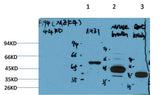
| Validation evidence captions | Western blot analysis of 1) A431 Cell Lysate, 2) Mouse Brain Tissue Lysate , 3) Rat Brain Tissue Lysate using MEK4(EA362)Rabbit pAb diluted at 1:2000. |
|---|
Key Facts
| Target | MEK4 (F194)Rabbit pAb |
| Also known as | JNK activating kinase 1, JNKK, JNKK1, MAP kinase kinase 4, MAP2K4, MAPK/ERK kinase 4, MAPKK 4, MAPKK4, MKK4, PRKMK4, SAPK/ERK kinase 1, SEK1, SERK1 |
| Concentration | 1mg/mL |
| Working concentration | WB 1:1,000-2,000 |
| Species reactivity | Human, Mouse, Rat |
| Observed band | 44kDa |
| Cellular localization | Cytoplasm, Nucleus |
| Form / buffer | Antibody solution |
| Research area | Antibody Research |
| Host species | Rabbit |
| Clonality | Polyclonal |
| Isotype | IgG |
| Conjugation | Unconjugated |
| Tested applications |
WB |
| Dilution range | WB 1:1,000-2,000 |
| Immunogen | Recombinant Protein |
Reactivity & Application Validation
3 speciess| Species | WB | IHC | IF | ELISA | IP | FCM | CHIP |
|---|---|---|---|---|---|---|---|
| Human | |||||||
| Mouse | |||||||
| Rat |
| Species | Dilution | Notes |
|---|---|---|
| Human | WB 1:1 | — |
| Mouse | — | — |
| Rat | — | — |
Specifications
Storage & Stability
Compliance & Certifications
Manufactured under ISO 9001:2015 quality management standards.
Not intended for diagnostic or therapeutic use.