
Anti-TPM1/2/3/4 Antibody Picoband®
Primary Antibody supplied by Boster Bio Read more ›

Product Description
This gene is a member of the tropomyosin family of highly conserved, widely distributed actin-binding proteins involved in the contractile system of striated and smooth muscles and the cytoskeleton of non-muscle cells. Tropomyosin is composed of two alpha-helical chains arranged as a coiled-coil. It is polymerized end to end along the two grooves of actin filaments and provides stability to the filaments. The encoded protein is one type of alpha helical chain that forms the predominant tropomyosin of striated muscle, where it also functions in association with the troponin complex to regulate the calcium-dependent interaction of actin and myosin during muscle contraction. In smooth muscle and non-muscle cells, alternatively spliced transcript variants encoding a range of isoforms have been described. Mutations in this gene are associated with type 3 familial hypertrophic cardiomyopathy and dilated cardiomyopathy 1Y.
Product information
| Supplier | Boster Bio |
|---|---|
| ABMIUM evidence status | ABMIUM Verified™ collaborator-tested data |
| Catalogue reference | A01591-4 |
| Product category | Primary Antibodies |
| Reactive species | Human, Mouse, Rat |
| Tested applications | ELISA, Flow Cytometry, IHC, IHC-P, WB |
| Available conjugations | Unconjugated, Biotin, Cy3, Fluoro488, Fluoro550, Fluoro594, FITC, HRP, APC, PE, Fluoro647 |
| Gene name | TPM1/2/3/4 |
| Protein name | Tropomyosin alpha-1 chain |
| Immunogen | E.coli-derived human TPM1/2/3/4 recombinant protein (Position: M1-S245). |
| Host | Rabbit |
| Clonality | Polyclonal |
| Isotype | Rabbit IgG |
| Purification | Immunogen affinity purified. |
| Storage | At -20˚C for one year from date of receipt. After reconstitution, at 4°C for one month. It can also be aliquotted and stored frozen at -20˚C for six months. Avoid repeated freezing and thawing. |
| UniProt | P09493 |
| NCBI Gene ID | 7168 |
Available variants
| Conjugation | Size |
|---|---|
| Unconjugated | 100 μg/vial |
| Biotin | 100 μg/vial |
| Cy3 | 100 μg/vial |
| Fluoro488 | 100 μg/vial |
| Fluoro550 | 100 μg/vial |
| Fluoro594 | 100 μg/vial |
| FITC | 100 μg/vial |
| HRP | 100 μg/vial |
| APC | 100 μg/vial |
| PE | 100 μg/vial |
| Fluoro647 | 100 μg/vial |
Key Facts
| Target | Tropomyosin alpha-1 chain |
| Also known as | TPM1; C15orf13; TMSA; Tropomyosin alpha-1 chain; Alpha-tropomyosin; Tropomyosin-1; TPM2; TMSB; Tropomyosin beta chain; Beta-tropomyosin; Tropomyosin-2; TPM3; Tropomyosin alpha-3 chain; Gamma-tropomyosin; Tropomyosin-3; Tropomyosin-5; hTM5; TPM4; Tropomyosin alpha-4 chain; TM30p1; Tropomyosin-4 |
| Concentration | Adding 0.2 ml of distilled water will yield a concentration of 500 μg/ml. |
| Species reactivity | Human,Mouse,Rat |
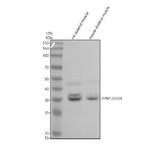
| Observed band | 33-40 kDa |
| Form / buffer | Lyophilized |
| Shelf life | At -20˚C for one year from date of receipt. After reconstitution, at 4°C for one month. It can also be aliquotted and stored frozen at -20˚C for six months. Avoid repeated freezing and thawing. |
| Host species | Rabbit |
| Clonality | Polyclonal |
| Isotype | Rabbit IgG |
| Conjugation | Unconjugated|Biotin|Cy3|Fluoro488|Fluoro550|Fluoro594|FITC|HRP|APC|PE|Fluoro647 |
| Non-cross-reactive with | No cross-reactivity with other proteins |
| Tested applications |
ELISAFlow CytometryIHCIHC-PWB |
| Dilution range | Western blot, 0.25-0.5 μg/ml, Mouse, Rat Immunohistochemistry(Paraffin-embedded Section), 2-5 μg/ml, Human, Mouse, Rat ELISA, 0.1-0.5 μg/ml |
| Immunogen | E.coli-derived human TPM1/2/3/4 recombinant protein (Position: M1-S245). |
| Purification | Immunogen affinity purified. |
Reactivity & Application Validation
3 speciess| Species | WB | IHC | IHC-P | IHC-F | IF/ICC | FLOW CYTOMETRY | ELISA | IP |
|---|---|---|---|---|---|---|---|---|
| Human | ||||||||
| Mouse | ||||||||
| Rat |
Specifications
Immunohistochemistry(Paraffin-embedded Section), 2-5 μg/ml, Human, Mouse, Rat
ELISA, 0.1-0.5 μg/ml
Storage & Stability
Compliance & Certifications
Not intended for diagnostic or therapeutic use.