
Anti-PBP/PEBP1 Antibody Picoband®
Primary Antibody supplied by Boster Bio Read more ›

Product Description
PEBP1 (Phosphatidylethanolamine-binding protein 1), also called PBP, RKIP, inhibits the phosphorylation and activation of MEK by RAF1. PEBP1 is identical to the phosphatidylethanolamine-binding protein (PBP) with a relative molecular mass of 23 kD. The PEBP1 gene is mapped on 12q24.23. PEBP1 coimmunoprecipitates with RAF1 and MEK from cell lysates and colocalizes with RAF1 when examined by confocal microscopy. PEBP1 overexpression interferes with the activation of MEK and ERK, induction of AP1-dependent reporter genes, and transformation elicited by an oncogenically activated RAF1 kinase. PEBP1 expression was rapidly upregulated during induction of chemotherapy-triggered apoptosis in human prostate and breast cancer cell lines, and maximal RKIP expression correlated perfectly with the onset of apoptosis by Chatterjee et al (2004). RKIP depletion decreased the mitotic index, the number of metaphase cells, traversal times from nuclear envelope breakdown to anaphase, and an override of mitotic checkpoints induced by spindle poisons.
Product information
| Supplier | Boster Bio |
|---|---|
| ABMIUM evidence status | ABMIUM Verified™ collaborator-tested data |
| Catalogue reference | PA1713 |
| Product category | Primary Antibodies |
| Reactive species | Mouse, Rat |
| Tested applications | ELISA, Flow Cytometry, IHC, IHC-P, WB |
| Available conjugations | Unconjugated, Biotin, Cy3, Fluoro488, Fluoro550, Fluoro594, FITC, HRP, APC, PE, Fluoro647 |
| Gene name | PEBP1 |
| Protein name | Phosphatidylethanolamine-binding protein 1 |
| Specificity | No cross reactivity with other proteins. |
| Immunogen | A synthetic peptide corresponding to a sequence at the N-terminus of mouse PBP, identical to the related rat sequence. |
| Host | Rabbit |
| Clonality | Polyclonal |
| Isotype | Rabbit IgG |
| Purification | Immunogen affinity purified. |
| Storage | Store at -20℃ for one year from date of receipt. After reconstitution, at 4℃ for one month. It can also be aliquotted and stored frozen at -20℃ for six months. Avoid repeated freeze-thaw cycles. |
| UniProt | P70296 |
| NCBI Gene ID | 23980 |
Available variants
| Conjugation | Size |
|---|---|
| Unconjugated | 100 μg/vial |
| Biotin | 100 μg/vial |
| Cy3 | 100 μg/vial |
| Fluoro488 | 100 μg/vial |
| Fluoro550 | 100 μg/vial |
| Fluoro594 | 100 μg/vial |
| FITC | 100 μg/vial |
| HRP | 100 μg/vial |
| APC | 100 μg/vial |
| PE | 100 μg/vial |
| Fluoro647 | 100 μg/vial |
Key Facts
| Target | Phosphatidylethanolamine-binding protein 1 |
| Also known as | HCNP; HCNPpp; Neuropolypeptide h3; PBP; PEBP; PEBP 1; PEBP1; Prostatic binding protein; Raf kinase inhibitor protein; RKIP |
| Concentration | Adding 0.2 ml of distilled water will yield a concentration of 500 μg/ml. |
| Species reactivity | Mouse,Rat |
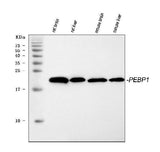
| Observed band | 21 kDa |
| Purity | No cross reactivity with other proteins. |
| Form / buffer | Lyophilized |
| Shelf life | Store at -20℃ for one year from date of receipt. After reconstitution, at 4℃ for one month. It can also be aliquotted and stored frozen at -20℃ for six months. Avoid repeated freeze-thaw cycles. |
| Host species | Rabbit |
| Clonality | Polyclonal |
| Isotype | Rabbit IgG |
| Conjugation | Unconjugated|Biotin|Cy3|Fluoro488|Fluoro550|Fluoro594|FITC|HRP|APC|PE|Fluoro647 |
| Non-cross-reactive with | No cross-reactivity with other proteins |
| Tested applications |
ELISAFlow CytometryIHCIHC-PWB |
| Dilution range | Immunohistochemistry (Paraffin-embedded Section), 0.5-1μg/ml, Rat Western blot, 0.1-0.5μg/ml, Mouse, Rat |
| Immunogen | A synthetic peptide corresponding to a sequence at the N-terminus of mouse PBP, identical to the related rat sequence. |
| Purification | Immunogen affinity purified. |
Reactivity & Application Validation
2 speciess| Species | WB | IHC | IHC-P | IHC-F | IF/ICC | FLOW CYTOMETRY | ELISA | IP |
|---|---|---|---|---|---|---|---|---|
| Mouse | ||||||||
| Rat |
Specifications
Western blot, 0.1-0.5μg/ml, Mouse, Rat
Storage & Stability
*This antibody is supplied in a stabilized formulation. Compatibility with conjugation reactions depends on the chemistry of the conjugation method used. For conjugation methods that are not compatible with the stabilizing components present in this formulation, a carrier-free antibody format is required.
Compliance & Certifications
Not intended for diagnostic or therapeutic use.