
Anti-Paxillin/PXN Antibody Picoband®
Primary Antibody supplied by Boster Bio Read more ›

Product Description
PXN(Paxillin) is a signal transduction adaptor protein discovered in 1990 in the laboratory of Keith Burridge. Salgia et al.(1995) mapped the paxillin gene to 12q24 using fluorescence in situ hybridization.The C-terminal region of paxillin contains four LIM domains that target paxillin to focal adhesions, it is presumed through a association with the cytoplasmic tail of beta-integrin. The N-terminal region of paxillin is rich in protein–protein interaction sites. The proteins that bind to paxillin are diverse and include protein tyrosine kinases, such as Src and FAK, structural proteins, such as vinculin and actopaxin, and regulators of actin organization, such as COOL/PIX and PKL/GIT. Paxillin is tyrosine-phosphorylated by FAK and Src upon integrin engagement or growth factor stimulation, creating binding sites for the adapter protein Crk.The paxillin protein contains 4 LIM domains, a proline-rich domain containing a consensus SH3-binding site, and 3 potential SH2-binding sites. On Northern blots, paxillin was expressed as a 3.7-kb mRNA in all tissues tested.
Product information
| Supplier | Boster Bio |
|---|---|
| ABMIUM evidence status | ABMIUM Verified™ collaborator-tested data |
| Catalogue reference | A01033-2 |
| Product category | Primary Antibodies |
| Reactive species | Human, Mouse, Rat |
| Tested applications | ELISA, Flow Cytometry, IHC, IHC-P, WB |
| Available conjugations | Unconjugated, Biotin, Cy3, Fluoro488, Fluoro550, Fluoro594, FITC, HRP, APC, PE, Fluoro647 |
| Gene name | PXN |
| Protein name | Paxillin |
| Immunogen | E.coli-derived human Paxillin/PXN recombinant protein (Position: A9-K570). |
| Host | Rabbit |
| Clonality | Polyclonal |
| Isotype | Rabbit IgG |
| Purification | Immunogen affinity purified. |
| Storage | At -20℃ for one year from date of receipt. After reconstitution, at 4℃ for one month. It can also be aliquotted and stored frozen at -20℃ for six months. Avoid repeated freezing and thawing. |
| UniProt | P49023 |
| NCBI Gene ID | 5829 |
Available variants
| Conjugation | Size |
|---|---|
| Unconjugated | 100 μg/vial |
| Biotin | 100 μg/vial |
| Cy3 | 100 μg/vial |
| Fluoro488 | 100 μg/vial |
| Fluoro550 | 100 μg/vial |
| Fluoro594 | 100 μg/vial |
| FITC | 100 μg/vial |
| HRP | 100 μg/vial |
| APC | 100 μg/vial |
| PE | 100 μg/vial |
| Fluoro647 | 100 μg/vial |
Key Facts
| Target | Paxillin |
| Also known as | paxillin; PXN |
| Concentration | Adding 0.2 ml of distilled water will yield a concentration of 500 μg/ml. |
| Species reactivity | Human,Mouse,Rat |
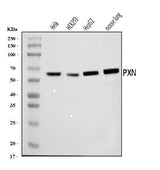
| Observed band | 65 kDa |
| Form / buffer | Lyophilized |
| Shelf life | At -20℃ for one year from date of receipt. After reconstitution, at 4℃ for one month. It can also be aliquotted and stored frozen at -20℃ for six months. Avoid repeated freezing and thawing. |
| Host species | Rabbit |
| Clonality | Polyclonal |
| Isotype | Rabbit IgG |
| Conjugation | Unconjugated|Biotin|Cy3|Fluoro488|Fluoro550|Fluoro594|FITC|HRP|APC|PE|Fluoro647 |
| Non-cross-reactive with | No cross-reactivity with other proteins. |
| Tested applications |
ELISAFlow CytometryIHCIHC-PWB |
| Dilution range | Western blot, 0.1-0.25 μg/ml, Human, Mouse Immunohistochemistry(Paraffin-embedded Section), 2-5 μg/ml, Human, Rat Flow Cytometry (Fixed), 1-3 μg/1x106 cells, Human ELISA, 0.1-0.5 μg/ml, - |
| Immunogen | E.coli-derived human Paxillin/PXN recombinant protein (Position: A9-K570). |
| Purification | Immunogen affinity purified. |
Reactivity & Application Validation
3 speciess| Species | WB | IHC | IHC-P | IHC-F | IF/ICC | FLOW CYTOMETRY | ELISA | IP |
|---|---|---|---|---|---|---|---|---|
| Human | ||||||||
| Mouse | ||||||||
| Rat |
Specifications
Immunohistochemistry(Paraffin-embedded Section), 2-5 μg/ml, Human, Rat
Flow Cytometry (Fixed), 1-3 μg/1x106 cells, Human
ELISA, 0.1-0.5 μg/ml, -
Storage & Stability
Compliance & Certifications
Not intended for diagnostic or therapeutic use.