
Anti-Myelin-associated glycoprotein MAG Antibody Picoband®
Primary Antibody supplied by Boster Bio Read more ›

Product Description
MAG (Myelin-associated glycoprotein),also known as SIGLEC4A, is a cell membrane glycoprotein that is a member of the SIGLEC family of proteins and is a functional ligand of the NOGO-66 receptor, NgR. It is though to be involved in the process of myelination. MAG is a sialic acid-binding SIGLEC protein and is a functional ligand for the NOGO receptor.The MAG gene is mapped on 19q13.12. Cleavage of GPI-linked proteins from axons protects growth cones from MAG-induced collapse, and dominant-negative NgR eliminates MAG inhibition of neurite outgrowth. MAG-resistant embryonic neurons were rendered MAG-sensitive by expression of NgR. MAG binds specifically to an NgR-expressing cell line in a GPI-dependent and sialic acid-independent manner. Experiments blocking NgR from interacting with MAG prevented inhibition of neurite outgrowth by MAG. In cultured human embryonic kidney (HEK) cells expressing the NOGO receptor, p75 (NTR) was required for MAG-induced intracellular calcium elevation.
Product information
| Supplier | Boster Bio |
|---|---|
| ABMIUM evidence status | ABMIUM Verified™ collaborator-tested data |
| Catalogue reference | PA1751 |
| Product category | Primary Antibodies |
| Reactive species | Mouse, Rat |
| Tested applications | ELISA, Flow Cytometry, IHC, IHC-P, WB |
| Available conjugations | Unconjugated, Biotin, Cy3, Fluoro488, Fluoro550, Fluoro594, FITC, HRP, APC, PE, Fluoro647 |
| Gene name | MAG |
| Protein name | Myelin-associated glycoprotein |
| Specificity | No cross reactivity with other proteins. |
| Immunogen | A synthetic peptide corresponding to a sequence at the N-terminus of human MAG, identical to the related rat and mouse sequences. |
| Host | Rabbit |
| Clonality | Polyclonal |
| Isotype | Rabbit IgG |
| Purification | Immunogen affinity purified. |
| Storage | Store at -20℃ for one year from date of receipt. After reconstitution, at 4℃ for one month. It can also be aliquotted and stored frozen at -20℃ for six months. Avoid repeated freeze-thaw cycles. |
| UniProt | P20916 |
| NCBI Gene ID | 4099 |
Available variants
| Conjugation | Size |
|---|---|
| Unconjugated | 100 μg/vial |
| Biotin | 100 μg/vial |
| Cy3 | 100 μg/vial |
| Fluoro488 | 100 μg/vial |
| Fluoro550 | 100 μg/vial |
| Fluoro594 | 100 μg/vial |
| FITC | 100 μg/vial |
| HRP | 100 μg/vial |
| APC | 100 μg/vial |
| PE | 100 μg/vial |
| Fluoro647 | 100 μg/vial |
Key Facts
| Target | Myelin-associated glycoprotein |
| Also known as | GMA; MAG; myelin associated glycoprotein; S MAG; SIGLEC 4A; SIGLEC4A |
| Concentration | Adding 0.2 ml of distilled water will yield a concentration of 500 μg/ml. |
| Species reactivity | Mouse,Rat |
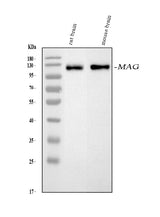
| Observed band | 100 kDa |
| Purity | No cross reactivity with other proteins. |
| Form / buffer | Lyophilized |
| Shelf life | Store at -20℃ for one year from date of receipt. After reconstitution, at 4℃ for one month. It can also be aliquotted and stored frozen at -20℃ for six months. Avoid repeated freeze-thaw cycles. |
| Host species | Rabbit |
| Clonality | Polyclonal |
| Isotype | Rabbit IgG |
| Conjugation | Unconjugated|Biotin|Cy3|Fluoro488|Fluoro550|Fluoro594|FITC|HRP|APC|PE|Fluoro647 |
| Non-cross-reactive with | No cross-reactivity with other proteins |
| Tested applications |
ELISAFlow CytometryIHCIHC-PWB |
| Dilution range | Immunohistochemistry (Paraffin-embedded Section), 2-5μg/ml, Mouse, Rat Western blot, 0.1-0.5μg/ml, Mouse, Rat |
| Immunogen | A synthetic peptide corresponding to a sequence at the N-terminus of human MAG, identical to the related rat and mouse sequences. |
| Purification | Immunogen affinity purified. |
Reactivity & Application Validation
2 speciess| Species | WB | IHC | IHC-P | IHC-F | IF/ICC | FLOW CYTOMETRY | ELISA | IP |
|---|---|---|---|---|---|---|---|---|
| Mouse | ||||||||
| Rat |
Specifications
Western blot, 0.1-0.5μg/ml, Mouse, Rat
Storage & Stability
*This antibody is supplied in a stabilized formulation. Compatibility with conjugation reactions depends on the chemistry of the conjugation method used. For conjugation methods that are not compatible with the stabilizing components present in this formulation, a carrier-free antibody format is required.
Compliance & Certifications
Not intended for diagnostic or therapeutic use.