
Anti-MCL1 Antibody Picoband®
Primary Antibody supplied by Boster Bio Read more ›

Product Description
BCL2L3, also known as MCL1 (myeloid cell leukemia sequence 1) encodes an anti-apoptotic protein, which is a member of the Bcl-2 family. Alternative splicing results in multiple transcript variants. The longest gene product (isoform 1) enhances cell survival by inhibiting apoptosis while the alternatively spliced shorter gene products (isoform 2 and isoform 3) promote apoptosis and are death-inducing. Using the methods of somatic cell hybrid analysis and fluorescence in situ hybridization), the MCL1 gene is mapped to human 1q21.MCL1is a critical and specific regulator essential for ensuring the homeostasis of early hematopoietic progenitors. Phosphorylation of MCL1 s its interaction with the tumor suppressor protein FBW7, which is the substrate-binding component of a ubiquitin ligase complex. The polyubiquitylation of MCL1 then targets it for proteasomal degradation. The degradation of MCL1 was blocked in patient-derived tumor cells that lacked FBW7 or had loss-of-function mutations in FBW7, conferring resistance to antitubulin agents and promoting chemotherapeutic-induced polyploidy.
Product information
| Supplier | Boster Bio |
|---|---|
| ABMIUM evidence status | ABMIUM Verified™ collaborator-tested data |
| Catalogue reference | PA1503 |
| Product category | Primary Antibodies |
| Reactive species | Human |
| Tested applications | ELISA, Flow Cytometry, IHC, IHC-P, WB |
| Available conjugations | Unconjugated, Biotin, Cy3, Fluoro488, Fluoro550, Fluoro594, FITC, HRP, APC, PE, Fluoro647 |
| Gene name | MCL1 |
| Protein name | Induced myeloid leukemia cell differentiation protein Mcl-1 |
| Specificity | No cross reactivity with other proteins. |
| Immunogen | A synthetic peptide corresponding to a sequence at the C-terminus of human MCL1, different from the related mouse sequence by one amino acid. |
| Host | Rabbit |
| Clonality | Polyclonal |
| Isotype | Rabbit IgG |
| Purification | Immunogen affinity purified. |
| Storage | Store at -20℃ for one year from date of receipt. After reconstitution, at 4℃ for one month. It can also be aliquotted and stored frozen at -20℃ for six months. Avoid repeated freeze-thaw cycles. |
| UniProt | Q07820 |
| NCBI Gene ID | 4170 |
Available variants
| Conjugation | Size |
|---|---|
| Unconjugated | 100 μg/vial |
| Biotin | 100 μg/vial |
| Cy3 | 100 μg/vial |
| Fluoro488 | 100 μg/vial |
| Fluoro550 | 100 μg/vial |
| Fluoro594 | 100 μg/vial |
| FITC | 100 μg/vial |
| HRP | 100 μg/vial |
| APC | 100 μg/vial |
| PE | 100 μg/vial |
| Fluoro647 | 100 μg/vial |
Key Facts
| Target | Induced myeloid leukemia cell differentiation protein Mcl-1 |
| Also known as | EAT; Mcl 1; Mcl 1l; Mcl 1s Delta TM; MCL1; mcl1/EAT; MCL1L; MCL1S; TM |
| Concentration | Adding 0.2 ml of distilled water will yield a concentration of 500 μg/ml. |
| Species reactivity | Human |
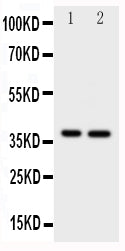
| Observed band | 37 kDa |
| Purity | No cross reactivity with other proteins. |
| Form / buffer | Lyophilized |
| Shelf life | Store at -20℃ for one year from date of receipt. After reconstitution, at 4℃ for one month. It can also be aliquotted and stored frozen at -20℃ for six months. Avoid repeated freeze-thaw cycles. |
| Host species | Rabbit |
| Clonality | Polyclonal |
| Isotype | Rabbit IgG |
| Conjugation | Unconjugated|Biotin|Cy3|Fluoro488|Fluoro550|Fluoro594|FITC|HRP|APC|PE|Fluoro647 |
| Non-cross-reactive with | No cross-reactivity with other proteins |
| Tested applications |
ELISAFlow CytometryIHCIHC-PWB |
| Dilution range | Western blot, 0.1-0.5μg/ml, Human |
| Immunogen | A synthetic peptide corresponding to a sequence at the C-terminus of human MCL1, different from the related mouse sequence by one amino acid. |
| Purification | Immunogen affinity purified. |
Reactivity & Application Validation
1 species| Species | WB | IHC | IHC-P | IHC-F | IF/ICC | FLOW CYTOMETRY | ELISA | IP |
|---|---|---|---|---|---|---|---|---|
| Human |
Specifications
Storage & Stability
*This antibody is supplied in a stabilized formulation. Compatibility with conjugation reactions depends on the chemistry of the conjugation method used. For conjugation methods that are not compatible with the stabilizing components present in this formulation, a carrier-free antibody format is required.
Compliance & Certifications
Not intended for diagnostic or therapeutic use.