
Anti-DPYD Antibody Picoband®
Primary Antibody supplied by Boster Bio Read more ›

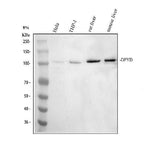
Product Description
DPYD (Dihydropyrimidine Dehydrogenase), also called DPD, is an enzyme that in humans is encoded by the DPYD gene. The protein encoded by this gene is a pyrimidine catabolic enzyme and the initial and rate-limiting factor in the pathway of uracil and thymidine catabolism. The structure of the DPYD gene contains 23 exons spanning about 950 kb. Using somatic cell hybrid strategies, the DPYD gene is mapped to the centromeric region of chromosome 1 between 1p22 and 1q21. By fluorescence in situ hybridization, the DPYD gene is mapped to 1p22. The highest level of DPD was found in monocytes followed by that in lymphocytes, granulocytes, and platelets, whereas no significant activity of DPD could be detected in erythrocytes. The activity of DPD in peripheral blood mononuclear cells was intermediate between that observed in monocytes and lymphocytes. By cDNA microarray, Western blot analysis, and luciferase reporter assay, the transcription factor LSF was identified as a positive regulator of DPYD.
Product information
| Supplier | Boster Bio |
|---|---|
| ABMIUM evidence status | ABMIUM Verified™ collaborator-tested data |
| Catalogue reference | PA1761 |
| Product category | Primary Antibodies |
| Reactive species | Human, Mouse, Rat |
| Tested applications | ELISA, Flow Cytometry, IHC, IHC-P, WB |
| Available conjugations | Unconjugated, Biotin, Cy3, Fluoro488, Fluoro550, Fluoro594, FITC, HRP, APC, PE, Fluoro647 |
| Gene name | DPYD |
| Protein name | Dihydropyrimidine dehydrogenase [NADP |
| Specificity | No cross reactivity with other proteins. |
| Immunogen | A synthetic peptide corresponding to a sequence at the N-terminus of human DPYD, different from the related rat and mouse sequences by one amino acid. |
| Host | Rabbit |
| Clonality | Polyclonal |
| Isotype | Rabbit IgG |
| Purification | Immunogen affinity purified. |
| Storage | Store at -20℃ for one year from date of receipt. After reconstitution, at 4℃ for one month. It can also be aliquotted and stored frozen at -20℃ for six months. Avoid repeated freeze-thaw cycles. |
| UniProt | Q12882 |
| NCBI Gene ID | 1806 |
Available variants
| Conjugation | Size |
|---|---|
| Unconjugated | 100 μg/vial |
| Biotin | 100 μg/vial |
| Cy3 | 100 μg/vial |
| Fluoro488 | 100 μg/vial |
| Fluoro550 | 100 μg/vial |
| Fluoro594 | 100 μg/vial |
| FITC | 100 μg/vial |
| HRP | 100 μg/vial |
| APC | 100 μg/vial |
| PE | 100 μg/vial |
| Fluoro647 | 100 μg/vial |
Key Facts
| Target | Dihydropyrimidine dehydrogenase NADP |
| Also known as | DHP; DHPDHASE; Dihydrothymine dehydrogenase; Dihydrouracil dehydrogenase; DPD; DPYD |
| Concentration | Adding 0.2 ml of distilled water will yield a concentration of 500 μg/ml. |
| Species reactivity | Human,Mouse,Rat |
| Observed band | 11 kDa |
| Purity | No cross reactivity with other proteins. |
| Form / buffer | Lyophilized |
| Shelf life | Store at -20℃ for one year from date of receipt. After reconstitution, at 4℃ for one month. It can also be aliquotted and stored frozen at -20℃ for six months. Avoid repeated freeze-thaw cycles. |
| Host species | Rabbit |
| Clonality | Polyclonal |
| Isotype | Rabbit IgG |
| Conjugation | Unconjugated|Biotin|Cy3|Fluoro488|Fluoro550|Fluoro594|FITC|HRP|APC|PE|Fluoro647 |
| Non-cross-reactive with | No cross-reactivity with other proteins |
| Tested applications |
ELISAFlow CytometryIHCIHC-PWB |
| Dilution range | Western blot, 0.1-0.5μg/ml, Human, Mouse, Rat Flow Cytometry(Fixed), 1-3 μg/1x106 cells, Human |
| Immunogen | A synthetic peptide corresponding to a sequence at the N-terminus of human DPYD, different from the related rat and mouse sequences by one amino acid. |
| Purification | Immunogen affinity purified. |
Reactivity & Application Validation
3 speciess| Species | WB | IHC | IHC-P | IHC-F | IF/ICC | FLOW CYTOMETRY | ELISA | IP |
|---|---|---|---|---|---|---|---|---|
| Human | ||||||||
| Mouse | ||||||||
| Rat |
Specifications
Flow Cytometry(Fixed), 1-3 μg/1x106 cells, Human
Storage & Stability
Compliance & Certifications
Not intended for diagnostic or therapeutic use.