
Anti-ATP6V1B1 Antibody Picoband®
Primary Antibody supplied by Boster Bio Read more ›

Product Description
V-type proton ATPase subunit B, kidney isoform is an enzyme that in humans is encoded by the ATP6V1B1 gene. This gene encodes a component of vacuolar ATPase (V-ATPase), a multisubunit enzyme that mediates acidification of eukaryotic intracellular organelles. V-ATPase dependent organelle acidification is necessary for such intracellular processes as protein sorting, zymogen activation, receptor-mediated endocytosis, and synaptic vesicle proton gradient generation. V-ATPase is composed of a cytosolic V1 domain and a transmembrane V0 domain. The V1 domain consists of three A and three B subunits, two G subunits plus the C, D, E, F, and H subunits. The V1 domain contains the ATP catalytic site. The V0 domain consists of five different subunits: a, c, c', c'', and d. Additional isoforms of many of the V1 and V0 subunit proteins are encoded by multiple genes or alternatively spliced transcript variants. This encoded protein is one of two V1 domain B subunit isoforms and is found in the kidney. Mutations in this gene cause distal renal tubular acidosis associated with sensorineural deafness.
Product information
| Supplier | Boster Bio |
|---|---|
| ABMIUM evidence status | ABMIUM Verified™ collaborator-tested data |
| Catalogue reference | A06073-2 |
| Product category | Primary Antibodies |
| Reactive species | Human |
| Tested applications | ELISA, Flow Cytometry, IHC, IHC-P, WB |
| Available conjugations | Unconjugated, Biotin, Cy3, Fluoro488, Fluoro550, Fluoro594, FITC, HRP, APC, PE, Fluoro647 |
| Gene name | ATP6V1B1 |
| Protein name | V-type proton ATPase subunit B, kidney isoform |
| Immunogen | E.coli-derived human ATP6V1B1 recombinant protein (Position: C17-L513). Human ATP6V1B1 shares 95.2% and 88.2% amino acid (aa) sequence identity with mouse and rat ATP6V1B1, respectively. |
| Host | Rabbit |
| Clonality | Polyclonal |
| Isotype | IgG |
| Purification | Immunogen affinity purified. |
| Storage | At -20℃ for one year from date of receipt. After reconstitution, at 4℃ for one month. It can also be aliquotted and stored frozen at -20℃ for six months. Avoid repeated freezing and thawing. |
| UniProt | P15313 |
| NCBI Gene ID | 525 |
Available variants
| Conjugation | Size |
|---|---|
| Unconjugated | 100 μg/vial |
| Biotin | 100 μg/vial |
| Cy3 | 100 μg/vial |
| Fluoro488 | 100 μg/vial |
| Fluoro550 | 100 μg/vial |
| Fluoro594 | 100 μg/vial |
| FITC | 100 μg/vial |
| HRP | 100 μg/vial |
| APC | 100 μg/vial |
| PE | 100 μg/vial |
| Fluoro647 | 100 μg/vial |
Key Facts
| Target | V-type proton ATPase subunit B, kidney isoform |
| Also known as | ATP6B1; ATP6V1B1; RTA1B; V ATPase subunit B 1; VATB; VMA2; VPP3 |
| Concentration | Adding 0.2 ml of distilled water will yield a concentration of 500 μg/ml. |
| Species reactivity | Human |
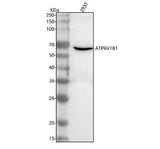
| Observed band | 69 kDa |
| Form / buffer | Lyophilized |
| Shelf life | At -20℃ for one year from date of receipt. After reconstitution, at 4℃ for one month. It can also be aliquotted and stored frozen at -20℃ for six months. Avoid repeated freezing and thawing. |
| Host species | Rabbit |
| Clonality | Polyclonal |
| Isotype | IgG |
| Conjugation | Unconjugated|Biotin|Cy3|Fluoro488|Fluoro550|Fluoro594|FITC|HRP|APC|PE|Fluoro647 |
| Tested applications |
ELISAFlow CytometryIHCIHC-PWB |
| Dilution range | Western blot, 0.25-0.5 μg/ml, Human ELISA, 0.1-0.5 μg/ml, - |
| Immunogen | E.coli-derived human ATP6V1B1 recombinant protein (Position: C17-L513). Human ATP6V1B1 shares 95.2% and 88.2% amino acid (aa) sequence identity with mouse and rat ATP6V1B1, respectively. |
| Purification | Immunogen affinity purified. |
Reactivity & Application Validation
1 species| Species | WB | IHC | IHC-P | IHC-F | IF/ICC | FLOW CYTOMETRY | ELISA | IP |
|---|---|---|---|---|---|---|---|---|
| Human |
Specifications
ELISA, 0.1-0.5 μg/ml, -
Storage & Stability
Compliance & Certifications
Not intended for diagnostic or therapeutic use.