
Anti-Aspartate beta hydroxylase/ASPH Antibody Picoband®
Primary Antibody supplied by Boster Bio Read more ›

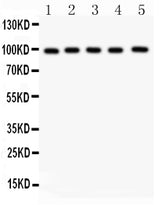
Product Description
ASPH is also known as Aspartyl/asparaginyl beta-hydroxylase. This gene is thought to play an important role in calcium homeostasis. And the gene is expressed from two promoters and undergoes extensive alternative splicing. The encoded set of proteins share varying amounts of overlap near their N-termini but have substantial variations in their C-terminal domains resulting in distinct functional properties. The longest isoforms (a and f) include a C-terminal Aspartyl/Asparaginyl beta-hydroxylase domain that hydroxylates aspartic acid or asparagine residues in the epidermal growth factor (EGF)-like domains of some proteins, including protein C, coagulation factors VII, IX, and X, and the complement factors C1R and C1S. Other isoforms differ primarily in the C-terminal sequence and lack the hydroxylase domain, and some have been localized to the endoplasmic and sarcoplasmic reticulum. Some of these isoforms are found in complexes with calsequestrin, triadin, and the ryanodine receptor, and have been shown to regulate calcium release from the sarcoplasmic reticulum. Some isoforms have been implicated in metastasis.
Product information
| Supplier | Boster Bio |
|---|---|
| ABMIUM evidence status | ABMIUM Verified™ collaborator-tested data |
| Catalogue reference | PB9478 |
| Product category | Primary Antibodies |
| Reactive species | Human, Mouse, Rat |
| Tested applications | ELISA, Flow Cytometry, IF/ICC, IHC, IHC-P, WB |
| Available conjugations | Unconjugated, Biotin, Cy3, Fluoro488, Fluoro550, Fluoro594, FITC, HRP, APC, PE, Fluoro647 |
| Gene name | ASPH |
| Protein name | Aspartyl/asparaginyl beta-hydroxylase |
| Specificity | No cross reactivity with other proteins. |
| Immunogen | A synthetic peptide corresponding to a sequence at the C-terminus of human ASPH, identical to the related mouse sequence. |
| Host | Rabbit |
| Clonality | Polyclonal |
| Isotype | Rabbit IgG |
| Purification | Immunogen affinity purified. |
| Storage | Store at -20℃ for one year from date of receipt. After reconstitution, at 4℃ for one month. It can also be aliquotted and stored frozen at -20℃ for six months. Avoid repeated freeze-thaw cycles. |
| UniProt | Q12797 |
| NCBI Gene ID | 444 |
Available variants
| Conjugation | Size |
|---|---|
| Unconjugated | 100 μg/vial |
| Biotin | 100 μg/vial |
| Cy3 | 100 μg/vial |
| Fluoro488 | 100 μg/vial |
| Fluoro550 | 100 μg/vial |
| Fluoro594 | 100 μg/vial |
| FITC | 100 μg/vial |
| HRP | 100 μg/vial |
| APC | 100 μg/vial |
| PE | 100 μg/vial |
| Fluoro647 | 100 μg/vial |
Key Facts
| Target | Aspartyl/asparaginyl beta-hydroxylase |
| Also known as | AAH; ASP beta hydroxylase; aspartate beta hydroxylase; ASPH; BAH; CASQ2BP1; HAAH; JCTN; junctin |
| Concentration | Adding 0.2 ml of distilled water will yield a concentration of 500 μg/ml. |
| Species reactivity | Human,Mouse,Rat |
| Observed band | 100 kDa |
| Purity | No cross reactivity with other proteins. |
| Form / buffer | Lyophilized |
| Shelf life | Store at -20℃ for one year from date of receipt. After reconstitution, at 4℃ for one month. It can also be aliquotted and stored frozen at -20℃ for six months. Avoid repeated freeze-thaw cycles. |
| Host species | Rabbit |
| Clonality | Polyclonal |
| Isotype | Rabbit IgG |
| Conjugation | Unconjugated|Biotin|Cy3|Fluoro488|Fluoro550|Fluoro594|FITC|HRP|APC|PE|Fluoro647 |
| Non-cross-reactive with | No cross-reactivity with other proteins |
| Tested applications |
ELISAFlow CytometryIF/ICCIHCIHC-PWB |
| Dilution range | Western blot, 0.1-0.5μg/ml, Human, Mouse, Rat Immunohistochemistry (Paraffin-embedded Section), 0.5-1μg/ml, Human Immunocytochemistry, 0.5-1μg/ml, Human Flow Cytometry (Fixed), 1-3μg/1x106 cells, Human |
| Immunogen | A synthetic peptide corresponding to a sequence at the C-terminus of human ASPH, identical to the related mouse sequence. |
| Purification | Immunogen affinity purified. |
Reactivity & Application Validation
3 speciess| Species | WB | IHC | IHC-P | IHC-F | IF/ICC | FLOW CYTOMETRY | ELISA | IP |
|---|---|---|---|---|---|---|---|---|
| Human | ||||||||
| Mouse | ||||||||
| Rat |
Specifications
Immunohistochemistry (Paraffin-embedded Section), 0.5-1μg/ml, Human
Immunocytochemistry, 0.5-1μg/ml, Human
Flow Cytometry (Fixed), 1-3μg/1x106 cells, Human
Storage & Stability
*This antibody is supplied in a stabilized formulation.
Compatibility with conjugation reactions depends on the chemistry of the conjugation method used.
For conjugation methods that are not compatible with the stabilizing components present in this formulation, a carrier-free antibody format is required.
Compliance & Certifications
Not intended for diagnostic or therapeutic use.