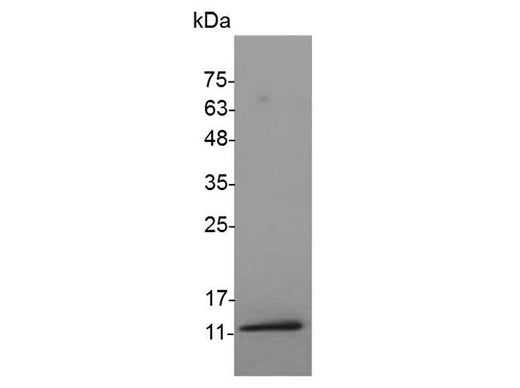
Recombinant Mouse IGF1(Long-R3-IGF1) Protein (His Tag) supplied by Elabscience with collaborator-provided technical specifications.
Know who made it. See the evidence. Buy through one marketplace.
Recombinant Mouse IGF1(Long-R3-IGF1) Protein (His Tag) is a research-use recombinant protein from Elabscience preparation representing IGF1 supplied as Lyophilized. Review the expression, purity, formulation and storage specifications below before selecting it for an assay or functional workflow.
Fully tested in-house by ABMIUM. Highest confidence. Non-conformities fully supported under the ABMIUM Product Promise.
Quality verified. Independent collaborator or expected-performance data available. Product meets ABMIUM quality standards.
Expected to work based on structural and biochemical data. Not yet directly tested by ABMIUM or a collaborator. No non-conformity support for this combination.
Not recommended for this application or species/sample combination. This may indicate either evidence of unsuitability or that the combination has not been tested and therefore cannot currently be recommended.
Evidence status by application and model.
| Species | Bioactivity | Binding | Cell-Based | In Vivo | ELISA Capture |
|---|---|---|---|---|---|
| Mouse |
This product is manufactured by Elabscience and sold through ABMIUM without relabelling.
ABMIUM supports global orders. Availability, shipping requirements and applicable import arrangements are confirmed before fulfilment where required.
Yes. Send your target, sample, application and experimental conditions through ABMIUM MATCH or technical support.
Unless the listing expressly states otherwise, ABMIUM products are supplied for research use only and are not for diagnostic or therapeutic use.
IGF1 identifies insulin like growth factor 1 in Homo sapiens (Human). This target record connects NCBI Gene 3479, UniProtKB P05019 and related ABMIUM catalogue products.
Biological function: IGF1 is a growth factor related to insulin that promotes cellular growth and anabolic responses and can regulate glucose uptake, glycogen synthesis and DNA synthesis in responsive cells.