SRSF9 Kaninchen-pAk von ELK Biotechnology Read more ›

SRSF9 rabbit pAb is a research-use antibody from ELK Biotechnology for studying SRSF9 in WB, ELISA workflows with listed reactivity for Human, Rat, Mouse. Specifications and supporting documents below should be reviewed when planning the experiment.
The protein encoded by this gene is a member of the serine/arginine (SR)-rich family of pre-mRNA splicing factors, which constitute part of the spliceosome. Each of these factors contains an RNA recognition motif (RRM) for binding RNA and an RS domain for binding other proteins. The RS domain is rich in serine and arginine residues and facilitates interaction between different SR splicing factors. In addition to being critical for mRNA splicing, the SR proteins have also been shown to be involved in mRNA export from the nucleus and in translation. Two pseudogenes, one on chromosome 15 and the other on chromosome 21, have been found for this gene. [provided by RefSeq, Sep 2010],
| Specificity | SRSF9 Polyclonal Antibody detects endogenous levels of protein. |
|---|---|
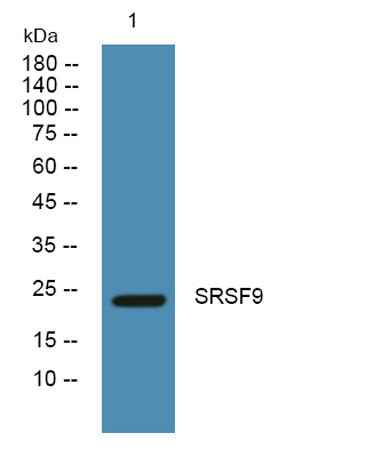
| Validation evidence captions | Western blot analysis of lysates from U2OS cells, primary antibody was diluted at 1:1000, 4°over night |
| Collaborator | ELK Biotechnology |
| Partner model | ES10312 |
| Target | SRSF9 |
| Research areas | >>Spliceosome, >>Herpes simplex virus 1 infection |
| Reactivity | Mensch;Ratte;Maus |
| Applications | WB,ELISA |
| Conjugation | Unkonjugiert |
| Dilution range | WB 1:500-2000 ELISA 1:5000-20000 |
| Host | Kaninchen |
| Clonality | Polyklonal |
| Isotype | IgG |
| Immunogen | Synthetisiertes Peptid, das von einem Teilbereich eines menschlichen Proteins stammt |
| Concentration | 1 mg/ml |
| Purification | Der Antikörper wurde mittels Affinitätschromatographie unter Verwendung eines Epitop-spezifischen Immunogens aus Kaninchenantiserum affinitätsgereinigt. |
| Assay type | Antikörpervalidierung/-anwendung |
| Expression system | Wird in hohen Mengen im Herzen, in den Nieren, der Bauchspeicheldrüse und der Plazenta exprimiert, in geringeren Mengen im Gehirn, der Leber, der Lunge und der Skelettmuskulatur. |
| Purity | Der Antikörper wurde mittels Affinitätschromatographie unter Verwendung eines Epitop-spezifischen Immunogens aus Kaninchenantiserum affinitätsgereinigt. |
| Species | WB | IHC | IF | ELISA | IP | FCM | ChIP |
|---|---|---|---|---|---|---|---|
| Mensch | |||||||
| Ratte | |||||||
| Maus |
| Species | Dilution | Notes |
|---|---|---|
| Mensch | WB 1:500-2000 ELISA 1:5000-20000 | — |
| Ratte | — | — |
| Maus | — | — |
| Species | Dilution | Notes |
|---|
Collaborator meets ABMIUM quality standards and overall product performance standards have been met.
Quality management certification.
For research applications. Not for diagnostic use.
No customer reviews yet.