
Cleaved-Cathepsin L1 HC (T288) Kaninchen-pAk von ELK Biotechnology Read more ›

Cleaved-Cathepsin L1 HC (T288) rabbit pAb is a research-use antibody from ELK Biotechnology for studying Cathepsin L in WB, ELISA workflows with listed reactivity for Human, Rat, Mouse. Specifications and supporting documents below should be reviewed when planning the experiment.
The protein encoded by this gene is a lysosomal cysteine proteinase that plays a major role in intracellular protein catabolism. Its substrates include collagen and elastin, as well as alpha-1 protease inhibitor, a major controlling element of neutrophil elastase activity. The encoded protein has been implicated in several pathologic processes, including myofibril necrosis in myopathies and in myocardial ischemia, and in the renal tubular response to proteinuria. This protein, which is a member of the peptidase C1 family, is a dimer composed of disulfide-linked heavy and light chains, both produced from a single protein precursor. Multiple alternatively spliced transcript variants have been found for this gene. [provided by RefSeq, Apr 2012],
| Specificity | Cleaved-Cathepsin L1 HC (T288) Polyclonal Antibody detects endogenous levels of fragment of activated Cathepsin L1 HC protein resulting from cleavage adjacent to T288. |
|---|---|
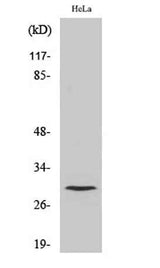
| Validation evidence captions | Western Blot analysis of various cells using Cleaved-Cathepsin L1 HC (T288) Polyclonal Antibody | Western blot analysis of lysates from HeLa cells, treated with etoposide 25uM 1h, using CATL1 (heavy chain,Cleaved-Thr288) Antibody. The lane on the right is blocked with the synthesized peptide. |
| Collaborator | ELK Biotechnology |
| Partner model | ES1029 |
| Target | Kathepisn L |
| Research areas | >>Autophagy - animal, >>Lysosome, >>Phagosome, >>Apoptosis, >>Antigen processing and presentation, >>Proteoglycans in cancer, >>Rheumatoid arthritis, >>Fluid shear stress and atherosclerosis |
| Reactivity | Mensch;Ratte;Maus; |
| Applications | WB,ELISA |
| Conjugation | Unkonjugiert |
| Dilution range | Western Blot: 1/500 - 1/2000. ELISA: 1/10000. Noch nicht in anderen Anwendungen getestet. |
| Host | Kaninchen |
| Clonality | Polyklonal |
| Isotype | IgG |
| Immunogen | Das Antiserum wurde gegen ein synthetisiertes Peptid produziert, das von humanem CATL1 abgeleitet wurde. AS-Bereich: 239-288 |
| Concentration | 1 mg/ml |
| Purification | Der Antikörper wurde mittels Affinitätschromatographie unter Verwendung eines Epitop-spezifischen Immunogens aus Kaninchenantiserum affinitätsgereinigt. |
| Assay type | Antikörpervalidierung/-anwendung |
| Expression system | Knorpel,Kolonendothel,Leber,Plasma,Prostata, |
| Purity | Der Antikörper wurde mittels Affinitätschromatographie unter Verwendung eines Epitop-spezifischen Immunogens aus Kaninchenantiserum affinitätsgereinigt. |
| Species | WB | IHC | IF | ELISA | IP | FCM | ChIP |
|---|---|---|---|---|---|---|---|
| Mensch | |||||||
| Ratte | |||||||
| Maus |
| Species | Dilution | Notes |
|---|---|---|
| Mensch | Western Blot: 1/500 - 1/2000. ELISA: 1/10000. Noch nicht in anderen Anwendungen getestet. | — |
| Ratte | — | — |
| Maus | — | — |
| Species | Dilution | Notes |
|---|
Collaborator meets ABMIUM quality standards and overall product performance standards have been met.
Quality management certification.
For research applications. Not for diagnostic use.
No customer reviews yet.
