
IP3R-I (phospho Ser1598) rabbit pAb from ELK Biotechnology Read more ›

IP3R-I (phospho Ser1598) rabbit pAb is a research-use antibody from ELK Biotechnology for studying IP3 Receptor in IHC, IF, ELISA workflows with listed reactivity for Human, Mouse, Rat. Specifications and supporting documents below should be reviewed when planning the experiment.
This gene encodes an intracellular receptor for inositol 1,4,5-trisphosphate. Upon stimulation by inositol 1,4,5-trisphosphate, this receptor mediates calcium release from the endoplasmic reticulum. Mutations in this gene cause spinocerebellar ataxia type 15, a disease associated with an heterogeneous group of cerebellar disorders. Multiple transcript variants have been identified for this gene. [provided by RefSeq, Nov 2009],
| Specificity | Phospho-IP3R-I (S1598) Polyclonal Antibody detects endogenous levels of IP3R-I protein only when phosphorylated at S1598. |
|---|---|
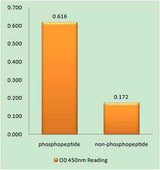
| Validation evidence captions | Enzyme-Linked Immunosorbent Assay (Phospho-ELISA) for Immunogen Phosphopeptide (Phospho-left) and Non-Phosphopeptide (Phospho-right), using Inositol 1,4,5-trisphosphate R1 (Phospho-Ser1598/1588) Antibody | Immunofluorescence analysis of A549 cells, using Inositol 1, 4, 5-trisphosphate R1 (Phospho-Ser1598/1588) Antibody. The picture on the right is blocked with the phospho peptide. | Immunohistochemistry analysis of paraffin-embedded human cervix carcinoma, using Inositol 1, 4, 5-trisphosphate R1 (Phospho-Ser1598/1588) Antibody. The picture on the right is blocked with the phospho peptide. |
| Collaborator | ELK Biotechnology |
| Partner model | ES5964 |
| Target | IP3 Receptor |
| Research areas | >>Calcium signaling pathway, >>cGMP-PKG signaling pathway, >>Phosphatidylinositol signaling system, >>Oocyte meiosis, >>Autophagy - animal, >>Apoptosis, >>Cellular senescence, >>Vascular smooth muscle contraction, >>Apelin signaling pathway, >>Gap junction, >>Platelet activation, >>NOD-like receptor signaling pathway, >>C-type lectin receptor signaling pathway, >>Circadian entrainment, >>Long-term potentiation, >>Retrograde endocannabinoid signaling, >>Glutamatergic synapse, >>Cholinergic synapse, >>Serotonergic synapse, >>Dopaminergic synapse, >>Long-term depression, >>Inflammatory mediator regulation of TRP channels, >>GnRH signaling pathway, >>Estrogen signaling pathway, >>Thyroid hormone synthesis, >>Oxytocin signaling pathway, >>Glucagon signaling pathway, >>Renin secretion, >>Aldosterone synthesis and secretion, >>Cortisol synthesis and secretion, >>Parathyroid hormone synthesis, secretion and action, >>GnRH secretion, >>Cushing syndrome, >>Growth hormone synthesis, >>Salivary secretion, >>Ga |
| Reactivity | Human,Mouse,Rat |
| Applications | IHC,IF,ELISA |
| Conjugation | Unconjugated |
| Dilution range | Immunohistochemistry: 1/100 - 1/300. Immunofluorescence: 1/200 - 1/1000. ELISA: 1/10000. Not yet tested in other applications. |
| Host | Rabbit |
| Clonality | Polyclonal |
| Isotype | IgG |
| Immunogen | The antiserum was produced against synthesized peptide derived from human Inositol 1,4,5-trisphosphate R1 around the phosphorylation site of Ser1598/1588. AA range:1566-1615 |
| Concentration | 1 mg/ml |
| Purification | The antibody was affinity-purified from rabbit antiserum by affinity-chromatography using epitope-specific immunogen. |
| Assay type | Antibody validation/application |
| Expression system | Widely expressed. |
| Purity | The antibody was affinity-purified from rabbit antiserum by affinity-chromatography using epitope-specific immunogen. |
| Species | WB | IHC | IF | ELISA | IP | FCM | ChIP |
|---|---|---|---|---|---|---|---|
| Human | |||||||
| Mouse | |||||||
| Rat |
| Species | Dilution | Notes |
|---|---|---|
| Human | Immunohistochemistry: 1/100 - 1/300. Immunofluorescence: 1/200 - 1/1000. ELISA: 1/10000. Not yet tested in other applications. | — |
| Mouse | — | — |
| Rat | — | — |
| Species | Dilution | Notes |
|---|
| Species | Dilution | Notes |
|---|
Collaborator meets ABMIUM quality standards and overall product performance standards have been met.
Quality management certification.
For research applications. Not for diagnostic use.
No customer reviews yet.
