COX3-Kaninchen-pAk von ELK Biotechnology
Know who made it. See the evidence. Buy through one marketplace.
COX3 Kaninchen-pAk ist ein ELK Biotechnology-Antikörper für Forschungsabläufe, die COX3 betreffen.
Krankheit: Defekte in MT-ATP6 sind eine Ursache für die infantile bilaterale Striatumnekrose [MIM:500003]. Die bilaterale Striatumnekrose ist eine neurologische Störung, die dem Leigh-Syndrom ähnelt. Krankheit: Defekte in MT-ATP6 sind eine Ursache für die Leber Hereditäre Optikusneuropathie (LHON) [MIM:535000]. LHON ist eine mütterlich vererbte Krankheit, die zu einem akuten oder subakuten Verlust des zentralen Sehvermögens aufgrund einer Sehnervenfunktionsstörung führt. Bei einigen Patienten wurden auch kardiale Reizleitungsstörungen und neurologische Defekte beschrieben. LHON resultiert aus primären mitochondrialen DNA-Mutationen, die die Komplexe der Atmungskette betreffen. Krankheit: Defekte in MT-ATP6 sind eine Ursache für das Leigh-Syndrom (LS) [MIM:256000]. LS ist eine schwere neurologische Störung, die durch beidseitig symmetrische nekrotische Läsionen in subkortikalen Hirnregionen gekennzeichnet ist. Krankheit: Defekte in MT-ATP6 sind die Ursache für neurogene Muskelschwäche, Ataxie und Retinitis pigmentosa (NARP) [MIM:551500]. Krankheit: Defekte in MT-CO3 sind eine Ursache für den Cytochrom-c-Oxidase-Mangel (COX-Mangel) [MIM:220110]; auch als mitochondrialer Komplex-IV-Mangel bezeichnet. Der COX-Mangel ist eine klinisch heterogene Störung. Die klinischen Merkmale reichen von isolierter Myopathie bis zu schwerer Multisystemerkrankung, mit Beginn vom Säuglingsalter bis zum Erwachsenenalter. Krankheit: Defekte in MT-CO3 sind eine Ursache für die Leber Hereditäre Optikusneuropathie (LHON) [MIM:535000]. LHON ist eine mütterlich vererbte Krankheit, die zu einem akuten oder subakuten Verlust des zentralen Sehvermögens aufgrund einer Sehnervenfunktionsstörung führt.
| Spezifität | COX3 Polyclonal Antibody weist endogene Proteinspiegel nach. |
|---|---|
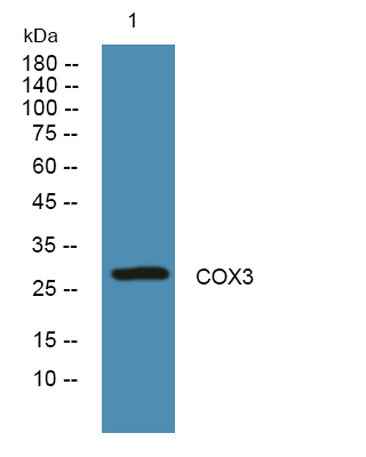
| Validierungsnachweisbeschriftungen | Western-Blot-Analyse von Lysaten aus U2OS-Zellen, Primärantikörper wurde 1:1000 verdünnt, 4° über Nacht |
Fully tested in-house by ABMIUM, or supported by an advanced validation report from a partner reviewed by ABMIUM. Highest confidence. Non-conformities fully supported under the ABMIUM Product Promise.
Quality verified. Independent collaborator or expected-performance data available. Product meets ABMIUM quality standards.
Expected to work based on structural and biochemical data. Not yet directly tested by ABMIUM or a collaborator. No non-conformity support for this combination.
Not recommended for this application or species/sample combination. This may indicate either evidence of unsuitability or that the combination has not been tested and therefore cannot currently be recommended.
Evidence status by application and model.
| Arten | WB | IHC | IF | ELISA | IP | FCM | ChIP |
|---|---|---|---|---|---|---|---|
| Mensch | |||||||
| Ratte | |||||||
| Maus |
This product is manufactured by ELK Biotechnology and sold through ABMIUM without relabelling.
ABMIUM supports global orders. Availability, shipping requirements and applicable import arrangements are confirmed before fulfilment where required.
Yes. Send your target, sample, application and experimental conditions through ABMIUM MATCH or technical support.
Unless the listing expressly states otherwise, ABMIUM products are supplied for research use only and are not for diagnostic or therapeutic use.