TRIP15 Kaninchen-pAk von ELK Biotechnology
Know who made it. See the evidence. Buy through one marketplace.
TRIP15 Kaninchen-pAk ist ein ELK-Biotechnologie-Antikörper für Forschungsabläufe, die TRIP15 betreffen.
Funktion: Wesentlicher Bestandteil des COP9-Signalosomkomplexes (CSN), eines Komplexes, der an verschiedenen zellulären und entwicklungsbedingten Prozessen beteiligt ist. Der CSN-Komplex ist ein essenzieller Regulator des Ubiquitin-(Ubl)-Konjugationsweges, indem er die Deneddylierung der Cullin-Untereinheiten von SCF-Typ-E3-Ligasenkomplexen vermittelt, was zu einer Abnahme der Ubl-Ligaseaktivität von SCF-Typ-Komplexen wie SCF, CSA oder DDB2 führt. Der Komplex ist auch an der Phosphorylierung von p53/TP53, c-jun/JUN, IkappaBalpha/NFKBIA, ITPK1 und IRF8/ICSBP beteiligt, möglicherweise durch seine Assoziation mit CK2- und PKD-Kinasen. Die CSN-abhängige Phosphorylierung von TP53 und JUN fördert bzw. schützt den Abbau durch das Ubl-System. Beteiligt an frühen Stadien der neuronalen Differenzierung über seine Interaktion mit NIF3L1., PTM: Phosphoryliert durch CK2- und PKD-Kinasen., Ähnlichkeit: Gehört zur CSN2-Familie., Ähnlichkeit: Enthält 1 PCI-Domäne., Untereinheit: Interagiert mit NIF3L1 (nach Ähnlichkeit). Bestandteil des CSN-Komplexes, bestehend aus COPS1/GPS1, COPS2, COPS3, COPS4, COPS5, COP6, COPS7 (COPS7A oder COPS7B) und COPS8. Im Komplex interagiert es wahrscheinlich direkt mit COPS1, COPS4, COPS5, COPS6 und COPS7 (COPS7A oder COPS7B). Interagiert mit CUL1 und CUL2. Interagiert spezifisch mit der Ligandenbindungsdomäne des Schilddrüsenrezeptors (TR). Benötigt kein Schilddrüsenhormon für seine Interaktion. Interagiert mit IRF8/ICSBP1 und mit den nukleären Rezeptoren NR2F1 und NR0B1.,
| Spezifität | TRIP15 polyklonaler Antikörper detektiert endogene Spiegel des TRIP15-Proteins. |
|---|---|
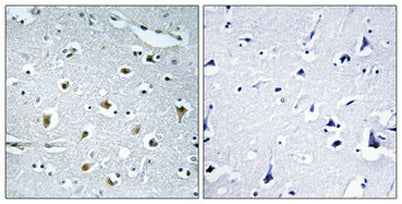
| Bildunterschriften zu Validierungsnachweisen | Immunhistochemische Analyse von paraffineingebettetem menschlichem Gehirn. Der Antikörper wurde 1:100 verdünnt (4° über Nacht). Hochdruck- und Temperatur-Tris-EDTA, pH 8,0 wurde zur Antigenrückgewinnung verwendet. Die negative Kontrolle (rechts) wurde durch Vorabsorption des Antikörpers mit Immunogenpeptid erhalten. | Immunfluoreszenzanalyse von A549-Zellen unter Verwendung des COPS2-Antikörpers. Das Bild rechts ist mit dem synthetisierten Peptid blockiert. | Western-Blot-Analyse von Lysaten aus COS7- und COLO205-Zellen unter Verwendung des COPS2-Antikörpers. Die Spur rechts ist mit dem synthetisierten Peptid blockiert. | Western-Blot-Analyse der Lysate aus 293-Zellen unter Verwendung des COPS2-Antikörpers. |
Fully tested in-house by ABMIUM, or supported by an advanced validation report from a partner reviewed by ABMIUM. Highest confidence. Non-conformities fully supported under the ABMIUM Product Promise.
Quality verified. Independent collaborator or expected-performance data available. Product meets ABMIUM quality standards.
Expected to work based on structural and biochemical data. Not yet directly tested by ABMIUM or a collaborator. No non-conformity support for this combination.
Not recommended for this application or species/sample combination. This may indicate either evidence of unsuitability or that the combination has not been tested and therefore cannot currently be recommended.
Evidence status by application and model.
| Arten | WB | IHC | IF | ELISA | IP | FCM | ChIP |
|---|---|---|---|---|---|---|---|
| Mensch | |||||||
| Maus | |||||||
| Ratte | |||||||
| Affe |
This product is manufactured by ELK Biotechnology and sold through ABMIUM without relabelling.
ABMIUM supports global orders. Availability, shipping requirements and applicable import arrangements are confirmed before fulfilment where required.
Yes. Send your target, sample, application and experimental conditions through ABMIUM MATCH or technical support.
Unless the listing expressly states otherwise, ABMIUM products are supplied for research use only and are not for diagnostic or therapeutic use.