
PACRG rabbit pAb from ELK Biotechnology Read more ›

PACRG rabbit pAb is a research-use antibody from ELK Biotechnology for studying PACRG in WB workflows with listed reactivity for Human, Mouse. Specifications and supporting documents below should be reviewed when planning the experiment.
This gene encodes a protein that is conserved across metazoans. In vertebrates, this gene is linked in a head-to-head arrangement with the adjacent parkin gene, which is associated with autosomal recessive juvenile Parkinson's disease. These genes are co-regulated in various tissues and they share a bi-directional promoter. Both genes are associated with susceptibility to leprosy. The parkin co-regulated gene protein forms a large molecular complex with chaperones, including heat shock proteins 70 and 90, and chaperonin components. This protein is also a component of Lewy bodies in Parkinson's disease patients, and it suppresses unfolded Pael receptor-induced neuronal cell death. Multiple transcript variants encoding different isoforms have been found for this gene. [provided by RefSeq, Jul 2008],
| Specificity | This antibody detects endogenous levels of PACRG at Human/Mouse |
|---|---|
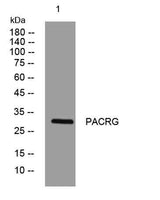
| Validation evidence captions | Western blot analysis of lysates from U2OS cells, primary antibody was diluted at 1:1000, 4°over night |
| Collaborator | ELK Biotechnology |
| Partner model | ES14280 |
| Target | PACRG |
| Research areas | Antibody Research |
| Reactivity | Human,Mouse |
| Applications | WB |
| Conjugation | Unconjugated |
| Dilution range | WB 1:500-2000 |
| Host | Rabbit |
| Clonality | Polyclonal |
| Isotype | IgG |
| Immunogen | Synthesized peptide derived from human PACRG AA range: 18-68 |
| Concentration | 1 mg/ml |
| Purification | The antibody was affinity-purified from rabbit serum by affinity-chromatography using specific immunogen. |
| Assay type | Antibody validation/application |
| Expression system | Expressed in all immune tissues, spleen, lymph nodes, thymus, tonsils, leukocyte and bone marrow. Expressed also in heart, brain, skeletal muscle, kidney, lung and pancreas. Expressed in primary Schwann cells and very weakly by monocyte-derived macrophages the primary host cells of Mycobacterium leprae, the causative agent of leprosy. Component of Lewy bodies, intraneuronal inclusions found in the brain of Parkinson disease patients. |
| Purity | The antibody was affinity-purified from rabbit serum by affinity-chromatography using specific immunogen. |
| Species | WB | IHC | IF | ELISA | IP | FCM | ChIP |
|---|---|---|---|---|---|---|---|
| Human | |||||||
| Mouse |
| Species | Dilution | Notes |
|---|---|---|
| Human | WB 1:500-2000 | — |
| Mouse | — | — |
Collaborator meets ABMIUM quality standards and overall product performance standards have been met.
Quality management certification.
For research applications. Not for diagnostic use.
No customer reviews yet.
