

An isotype control is a non specific antibody, matched to your primary antibody for host species, immunoglobulin isotype and conjugate, run alongside your assay to measure background staining rather than genuine target binding. Its job is narrow: it tells you how much signal comes from Fc receptor interactions, non specific tissue or plate binding, and conjugate artefacts rather than from the antigen you are actually studying.

That narrow job is exactly why isotype controls get misused. They are not designed to set gates in flow cytometry, and using one that way is one of the most persistent errors in antibody based work.
For the immediate practical points:
- An isotype control shares species, isotype/subclass and conjugate with your primary antibody, but lacks specificity for your target.
- It measures non specific background, primarily from Fc receptor binding and fluorophore or enzyme artefacts.
- It should never be used to set gates or compensation. FMO controls are the correct tool for that job.
Key Takeaways
Isotype controls work when matched precisely on species, subclass, conjugate and concentration, and fail when used for gating or bought without provenance documentation.
| Point | Details |
|---|---|
| Definition stays narrow | An isotype control measures non specific background; it does not confirm target specificity on its own. |
| Match on every axis | Species, Ig subclass, conjugate and F/P ratio all need to align between primary and control. |
| Titrate by concentration | Use µg/mL for both primary and isotype control rather than relying on dilution factors. |
| Never use for gating | FMO controls, not isotype controls, are the correct tool for setting gates in multicolour panels. |
| Provenance reduces mismatch | Abmium’s pre purchase validation and certificate of analysis documentation help confirm control suitability before you order. |
Table of Contents
- What is an isotype control and why does non specific binding happen?
- Where isotype controls actually help (and where they mislead)
- How to choose isotype controls that match your primary antibody
- Where isotype controls fail and what to use instead
- Titration, blocking and record keeping at the bench
- Why verified sourcing changes the isotype control conversation
- What the evidence actually supports about isotype controls
- Order verified isotype controls and get validation support from Abmium
- Sources
- FAQ
What is an isotype control and why does non specific binding happen?
Every antibody has a heavy chain that determines its isotype (IgG, IgM, IgA, IgE, IgD) and, within IgG, a subclass (IgG1, IgG2a, IgG2b, IgG3 in mice; IgG1 through IgG4 in humans). These distinctions matter because the Fc region, not the antigen binding site, is what determines how strongly an antibody engages Fc receptors on the surface of monocytes, macrophages, natural killer cells and B cells.
Three factors drive background signal, and each maps onto a step in isotype control selection:
- Fc receptor engagement. Cells rich in Fc receptors bind antibodies through the Fc tail regardless of antigen specificity, producing signal that has nothing to do with your target.
- Conjugate chemistry. A fluorophore or enzyme attached to the antibody can itself stick non specifically to cells, tissue or plastic, independent of the antibody backbone.
- Fluorophore to protein (F/P) ratio. A poorly controlled conjugation reaction produces antibodies carrying more or fewer fluorophore molecules than expected, which shifts brightness and complicates comparison between primary and control.
An isotype control matched on all three fronts isolates background from real signal. Get any one wrong and the comparison becomes unreliable.
Where isotype controls actually help (and where they mislead)
Isotype controls are most useful in flow cytometry surface staining, particularly for low expressed markers or rare cell populations where a small amount of non specific binding can be mistaken for genuine positivity. In immunohistochemistry and immunofluorescence, they reveal whether an enzyme or fluorophore is sticking to connective tissue, necrotic regions or Fc receptor rich immune infiltrates rather than the antigen under study. In ELISA and western blot work, an isotype control checks whether the detection reagent or the plate/membrane itself is generating background independent of antigen recognition.
Where they fall down is intracellular staining, compensation and gating. Permeabilisation changes the cell’s binding chemistry substantially, so a control designed for surface conditions does not necessarily reflect intracellular background accurately.
- Flow cytometry: strongest evidence base, especially for surface markers on Fc receptor bearing cells.
- IHC/IF: useful for spotting sticky conjugates and tissue autofluorescence, less reliable across different tissue blocks and fixation protocols.
- ELISA/western blot: helps flag detection antibody or substrate related background, not target specific.
- Intracellular staining and multicolour gating: isotype controls are not the appropriate tool, as several flow cytometry protocols make clear.
How to choose isotype controls that match your primary antibody
Selection precision determines whether an isotype control tells you anything useful at all. A mismatched control can either overstate background, prompting you to discard a genuinely positive result, or understate it, letting a false positive slide through unchallenged.
Work through the following in order:
- Match host species and Ig class/subclass exactly. A mouse IgG1 primary needs a mouse IgG1 isotype control, not a generic “mouse IgG” product. Subclass differences change Fc receptor affinity meaningfully.
- Match the conjugate and aim for a comparable F/P ratio. Two antibodies labelled with the same fluorophore can still behave differently if their F/P ratios diverge; request F/P data from the supplier when it isn’t listed on the datasheet.
- Titrate by concentration (µg/mL), not by dilution factor. Dilution factors assume identical stock concentrations between primary and control, which is rarely true. Titrating both reagents to the same µg/mL working concentration is the only fair comparison.
- Buy from the same supplier as your primary antibody where possible. Conjugation protocols and antibody purification methods vary between manufacturers, and these differences in labelling and aggregation state can shift background readings even when the isotype nominally matches.
- Consider light chain matching and functional grade reagents for in vivo or highly sensitive assays. Kappa versus lambda light chain composition can subtly affect Fc interactions in some systems, and in vivo work often demands azide free, low endotoxin formulations.
Pro Tip: Keep a running spreadsheet of every isotype control you purchase, recording supplier, catalogue number, lot, F/P ratio and the primary antibody it was matched against. When a result looks odd months later, that record is often the fastest way to rule out a reagent mismatch.
Where isotype controls fail and what to use instead
Isotype controls cannot substitute for FMO controls when you’re setting gates in a multicolour panel. Spillover from adjacent fluorophores is a fundamentally different problem from Fc mediated background, and an isotype control tells you nothing about it. Using one to draw a gate boundary is a documented and persistent misuse across flow cytometry literature.
Supplier to supplier variation in F/P ratio and antibody aggregation also means an isotype control from one manufacturer paired with a primary from another can produce misleading comparisons, even when both are labelled with the same fluorophore.
Practical complements worth building into your panel design:
- FMO controls for setting gates in any panel with more than a handful of colours.
- Fc receptor blocking reagents applied before staining, particularly on monocyte or macrophage rich samples.
- Dead cell exclusion dyes, since necrotic and apoptotic cells bind antibodies non specifically regardless of isotype matching.
- Isoclonic or unlabelled competition controls, which use excess unconjugated primary antibody to confirm specific binding directly rather than by inference.
Titration, blocking and record keeping at the bench
Getting a usable isotype control result depends more on bench technique than on the reagent itself. A well matched control run without proper titration or blocking still produces noise you cannot interpret.
- Titrate primary and isotype control in parallel. Start with a wide concentration range for both reagents, then narrow towards the working µg/mL concentration that gives the clearest separation between signal and background.
- Block before staining. BSA or serum blocks reduce non specific plate or tissue binding, and Fc receptor blocking reagents specifically address antibody binding through Fc receptors rather than general stickiness.
- Sequence your staining and washing carefully. Apply live/dead exclusion early, wash thoroughly between steps, and stain isotype and primary tubes under identical conditions and timings.
- Interpret similar looking histograms critically. If primary and isotype signals overlap substantially, check for antibody aggregation, run a conjugate only control, and confirm the lot number matches what you validated previously.
- Log everything. Supplier, lot number, concentration, F/P ratio, incubation time and temperature belong in your lab notebook for every isotype control run, not just the primary antibody.
Pro Tip: If a titration curve for your isotype control looks unusually steep or noisy compared with previous lots, suspect aggregation before you suspect biology. A quick spin at high speed to pellet aggregates before staining often resolves the issue.
Why verified sourcing changes the isotype control conversation
Much of the frustration researchers report with isotype controls traces back to reagent provenance rather than experimental design. A control bought without a clear certificate of analysis, undisclosed F/P ratio, or unverified lot history introduces a variable you cannot account for, no matter how carefully you titrate.
Abmium’s approach to antibody sourcing addresses this directly: every listed reagent goes through pre purchase validation and provenance review before it reaches a catalogue page, which reduces the lot to lot variability that undermines isotype matching in the first place. When ordering, request the certificate of analysis, F/P ratio, and endotoxin or aggregate data for both your primary antibody and its matched control.
- Ask for CoA documentation covering purity, concentration and lot number.
- Request F/P ratio data rather than assuming it matches the primary antibody’s labelling.
- Check for endotoxin and aggregate testing where the assay is sensitive to either.
- Consider independent validation against a known negative sample panel before committing to a full experimental run.
What the evidence actually supports about isotype controls
Most guidance on isotype controls repeats the same checklist: match species, match subclass, match conjugate. That advice is correct, but it understates how much supplier variation undermines it in practice. Two antibodies can carry identical labels on the datasheet, same host, same subclass, same fluorophore, and still produce different background because their F/P ratios or aggregation states diverge between manufacturing batches.
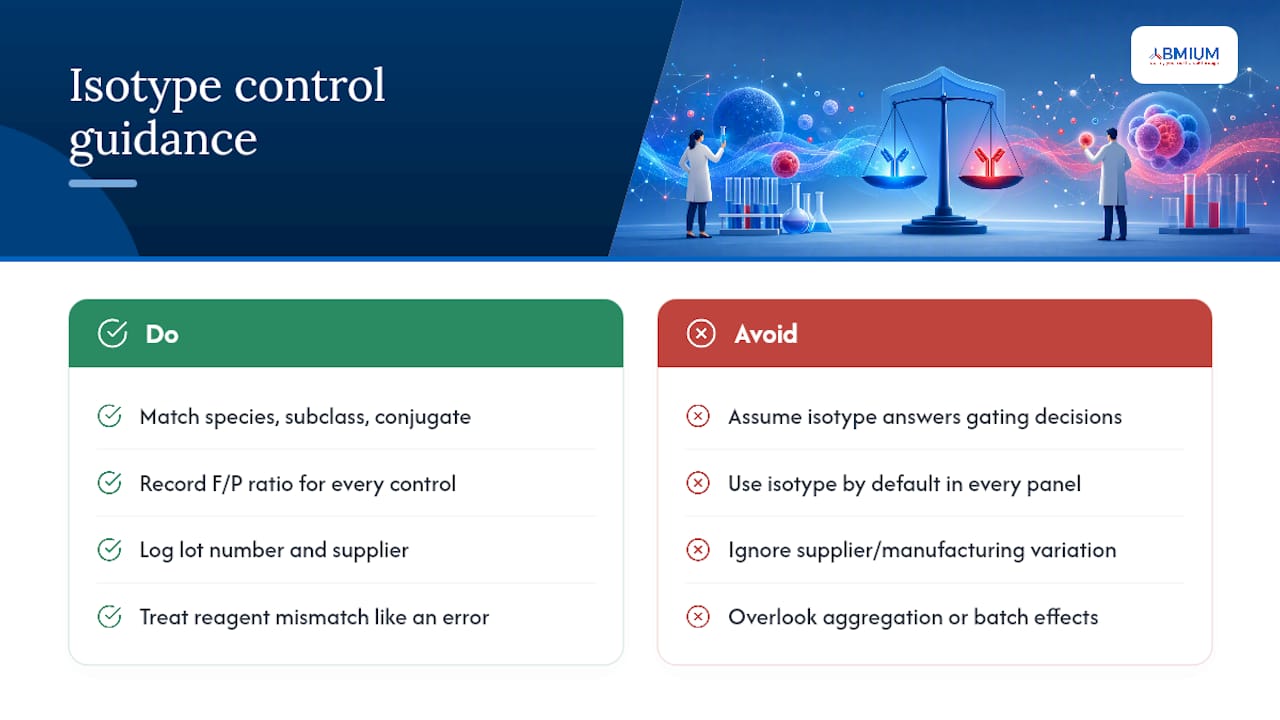
The conventional advice also tends to treat isotype controls as a default inclusion in every panel, when the more useful question is whether an isotype control answers the question you are actually asking. For gating decisions, it never will. For flagging Fc mediated background on a new cell population, it often does the job well.
If I had to prioritise one change for most labs, it would not be a more elaborate control scheme. It would be tighter documentation discipline: knowing the F/P ratio, lot number and supplier of every control in your freezer, and treating a mismatch there with the same seriousness as a pipetting error. Reagent provenance is the quiet variable behind a surprising number of irreproducible flow cytometry results.
Order verified isotype controls and get validation support from Abmium
Abmium gives you a shortcut past the reagent guesswork that undermines so many isotype control experiments: verified provenance and pre purchase validation on every listed antibody, so you are not left cross checking F/P ratios and lot histories on your own after an order lands.

Before contacting Abmium’s scientific support team, have three things ready: the exact primary antibody you are matching against (host, clone, subclass), your conjugate and F/P ratio requirements, and the intended assay, whether that is surface flow cytometry, intracellular staining, IHC or ELISA. That detail lets Abmium point you to a genuinely matched control rather than a nominal one.
Abmium’s catalogue includes matched primary and secondary antibodies such as the anti-mouse IgG antibody suitable as a non specific control base, alongside independent validation services for labs that want a negative sample panel run before committing to a full study. Browse the full catalogue of primary antibodies and reagents to check availability and request a quote for institutional or bulk orders.
Sources
- Practical flow cytometry—how to use controls and interpret flow data (PMC4053225)
- Isotype Controls in Flow Cytometry | Bio‑Rad
- Selecting Isotype Controls | Leinco Technologies
- Flow cytometry: basic principles and recent developments (PMC4212362)
FAQ
What are isotype controls?
An isotype control is a non specific antibody matched to your primary antibody’s host species, immunoglobulin isotype and conjugate, used to measure background staining rather than genuine antigen binding.
What are isotype controls used for in flow cytometry?
They help distinguish real positive staining from background caused by Fc receptor binding or conjugate artefacts, particularly for surface markers on Fc receptor rich cells such as monocytes and macrophages.

Can isotype controls be used to set gates?
No. Isotype controls do not account for spillover between fluorophores in multicolour panels, so FMO controls should be used for gating instead.
Why do isotype controls sometimes give inconsistent results?
Differences in F/P ratio, antibody aggregation, or supplier conjugation protocols between the primary antibody and the control are common causes, which is why matching concentration and sourcing from a verified supplier matters.
Do isotype controls work for intracellular staining?
They are less reliable there because permeabilisation changes binding conditions substantially compared with surface staining, so additional controls such as conjugate only tubes are often needed alongside them.