

The best reproducible antibody suppliers are the ones that publish knockout or orthogonal validation data, traceable lot provenance, and application-specific datasheets before you ever click “buy”. Citation counts and glossy product pages tell you an antibody is popular, not that it will work in your assay. Before you order anything, run three checks: does the datasheet name the exact application and cell line tested, does the supplier show raw validation images rather than a stock diagram, and can you trace the lot back to a batch record. ABMIUM builds its catalogue around exactly these checks, which is worth knowing before you commit budget to a reagent that might not survive replication.
- Confirm knockout, CRISPR, or orthogonal validation exists for your target
- Check the datasheet matches your exact application (WB, IHC, IF, FACS)
- Ask for lot-specific certificates of analysis before ordering in bulk
Key Takeaways
Reproducible antibody selection depends on knockout or orthogonal validation, traceable lot provenance, and application-matched datasheets rather than citation count alone.
| Point | Details |
|---|---|
| Prioritise knockout validation | Ask for KO or CRISPR validation images before trusting any specificity claim. |
| Demand lot traceability | Request a certificate of analysis tied to the specific lot you are purchasing. |
| Match validation to application | Confirm the datasheet was tested in your exact assay, not a related one. |
| Cross-check independent sources | Use CiteAb, GBSI, and UKRN data to verify supplier claims before ordering. |
| Choose transparent suppliers | ABMIUM publishes provenance and application-specific validation on every listed antibody. |
Table of Contents
- What makes an antibody reproducible?
- What questions should you ask an antibody vendor?
- Which validation methods actually prove specificity?
- How should a lab buy and verify an antibody?
- Do storage and handling affect antibody reproducibility?
- Where can you independently verify a supplier’s claims?
- How does ABMIUM support reproducible reagent selection?
- Sources
- FAQ
What makes an antibody reproducible?
Reproducibility for an antibody comes down to four things: specificity, sensitivity, lot-to-lot consistency, and a genuine match to your intended application. An antibody validated for western blot on denatured protein tells you nothing about how it will behave in immunohistochemistry on fixed tissue, yet plenty of catalogue listings blur that distinction.
The trust signals worth weighting most heavily are knockout or genetic validation, orthogonal confirmation by mass spectrometry, application-specific datasheets, and lot traceability back to a documented batch. A peer-reviewed study on antibody validation catalogues how often these controls are missing, and how that absence correlates with inconsistent results across labs running identical protocols.
Citation count on its own is a weak signal. A reagent can accumulate hundreds of citations simply by being an early market entrant, while quietly generating false positives that go unreported because negative results rarely get published. Novus Bio’s reproducibility resources frame this as the difference between popularity and proof, and it is a distinction worth internalising before you trust a “widely cited” label.
- Specificity: binds only the intended target, confirmed in knockout tissue or cells
- Sensitivity: detects the target at physiologically relevant concentrations
- Lot consistency: performance holds steady across manufacturing batches
- Application fit: validated in the exact assay you intend to run
Pro Tip: Where a knockout cell line or tissue exists for your target, ask the supplier for KO validation images before anything else. It is the single strongest specificity control available, and its absence should raise more questions than a missing citation count.
What questions should you ask an antibody vendor?
Procurement conversations go faster when you arrive with a short, specific checklist rather than a vague request for “good quality” reagents. Ask suppliers to answer these directly, in writing, before you place an order:
- Do you publish knockout or CRISPR validation images for this target?
- Can you provide a lot-specific certificate of analysis and batch provenance?
- Is the datasheet validated for my exact application, not just a related one?
- Has this antibody been confirmed by an independent third party or community database?
- What is your return or replacement policy if the lot fails to perform as described?
- Are recombinant versions available, and will future lots be sequence-locked for consistency?
Pricing transparency belongs on that list too. Ask about bulk discount tiers up front rather than after a purchase order is raised, and ask whether the antibody originates from a hybridoma clone or has been converted to a recombinant format, since recombinant conversion is what protects you from the clone drift that plagues long-running hybridoma lines. Suppliers who hesitate on any of these points are telling you something.
Which validation methods actually prove specificity?
Not every validation method proves the same thing, and vendors sometimes lean on the cheapest one to make. A single western blot band looks convincing, but it says nothing about performance in a fixed-tissue immunofluorescence assay. Understanding what each method actually demonstrates lets you judge a datasheet on its merits rather than its polish.
| Method | What it proves | Key limitation |
|---|---|---|
| Western blot | Correct molecular weight under denaturing conditions | Says nothing about native conformation or IHC/IF performance |
| Immunofluorescence / IHC | Subcellular or tissue localisation in fixed samples | Prone to background staining mistaken for real signal |
| Flow cytometry | Surface or intracellular marker detection in live cells | Antibody clone may cross-react with related family members |
| Immunoprecipitation | Ability to pull down native protein complexes | Does not confirm specificity, only successful binding |
| Knockout / CRISPR validation | True specificity, absence of signal when target is genetically removed | Requires access to a validated knockout line or tissue |
| Mass spectrometry (orthogonal) | Independent confirmation of target identity beyond antibody binding | Resource-intensive, not routinely offered by every supplier |
Image-only validation without a matched negative control is the weakest form of evidence a datasheet can offer, and it is worth treating with proportionate scepticism.
Pro Tip: For any target central to a publication or a long-term project, insist on knockout validation plus one orthogonal method. The combination catches the failure modes that either technique misses alone.
How should a lab buy and verify an antibody?
A disciplined purchase-to-bench workflow saves far more time than it costs, particularly on targets where a failed antibody could derail months of downstream work.
- Review the datasheet against your exact application, species, and sample type before ordering.
- Request the lot number and certificate of analysis in advance where the supplier allows it.
- Order the smallest available aliquot first rather than committing to a bulk purchase.
- Run a small-scale validation against a positive and negative control specific to your system.
- Record the lot number, datasheet version, validation images, and protocol conditions in your lab notebook.
- Only fold the antibody into a standard operating procedure once step five has produced consistent results.
Documentation matters as much as the bench work itself. A lot number without a saved datasheet snapshot is close to useless six months later when a reviewer asks how you validated the reagent.
Pro Tip: Conserve precious primary samples by titrating on a small pilot panel first, and ask whether a recombinant version with a locked sequence is available, since that protects you from unannounced clone changes in future lots.
Do storage and handling affect antibody reproducibility?
Storage conditions cause more reproducibility failures than most researchers assume, and they are entirely within your control. Repeated freeze thaw cycles degrade IgG structure and reduce binding activity, so aliquoting on arrival rather than after the third use is the simple fix most labs skip. Recombinant fragments and Fab formats often carry tighter thermal stability windows than full IgG, so treat the manufacturer’s stated storage temperature as a hard limit, not a suggestion.
- Aliquot immediately on receipt to avoid repeated freeze thaw cycles
- Match blocking buffer and antibody concentration to the validated protocol, not a generic default
- Log lot-to-lot performance drift over time rather than assuming consistency
- Inspect cold-chain packaging on arrival and flag any temperature excursion immediately
Pro Tip: Photograph shipping packaging and any included temperature indicator before opening. It is the fastest way to prove a cold-chain failure if a lot underperforms.
Where can you independently verify a supplier’s claims?
Supplier datasheets are a starting point, not the final word. Independent and community resources exist precisely to corroborate or challenge what a vendor publishes, and checking them costs nothing but a few minutes.
- CiteAb’s supplier data: shows citation concentration among widely used reagents and lists custom and recombinant antibody suppliers worth cross-referencing against a vendor’s own claims.
- GBSI workshop findings: consolidate genetic validation, orthogonal confirmation, and community checks as the three approaches that consistently improve antibody reliability.
- UKRN case studies: document how institutional training programmes measurably reduced wasted experiments tied to poor antibody selection.
- Application-specific marketplaces: platforms like antibodies-online filter reagents by validated application, which helps you spot gaps a single supplier’s page might hide.
A red flag worth remembering: an antibody with hundreds of citations but no independent validation entry anywhere is not proof of quality, just proof of longevity in the literature.
How does ABMIUM support reproducible reagent selection?
ABMIUM’s catalogue is structured around the checklist above rather than around volume sales. Every listing, including the Anti-Human CD276 antibody, carries lot-specific provenance and application-matched validation notes rather than a generic specificity claim borrowed from a related clone.
- Pre-purchase validation support, so you can query specificity evidence before an order is placed
- Lot traceability built into every product record, not offered only on request
- Recombinant conversion options for targets historically supplied only as hybridoma clones
- Independent validation services for labs that need third-party confirmation before publication
A Nature commentary on reproducibility pressures argues that transparent data sharing, not marketing claims, is what actually moves the field forward. ABMIUM’s product pages, including secondary antibodies such as the Anti-Mouse IgG antibody, are built on that same principle: show the provenance, and let the researcher judge it directly.
Why validated provenance beats a longer citation list
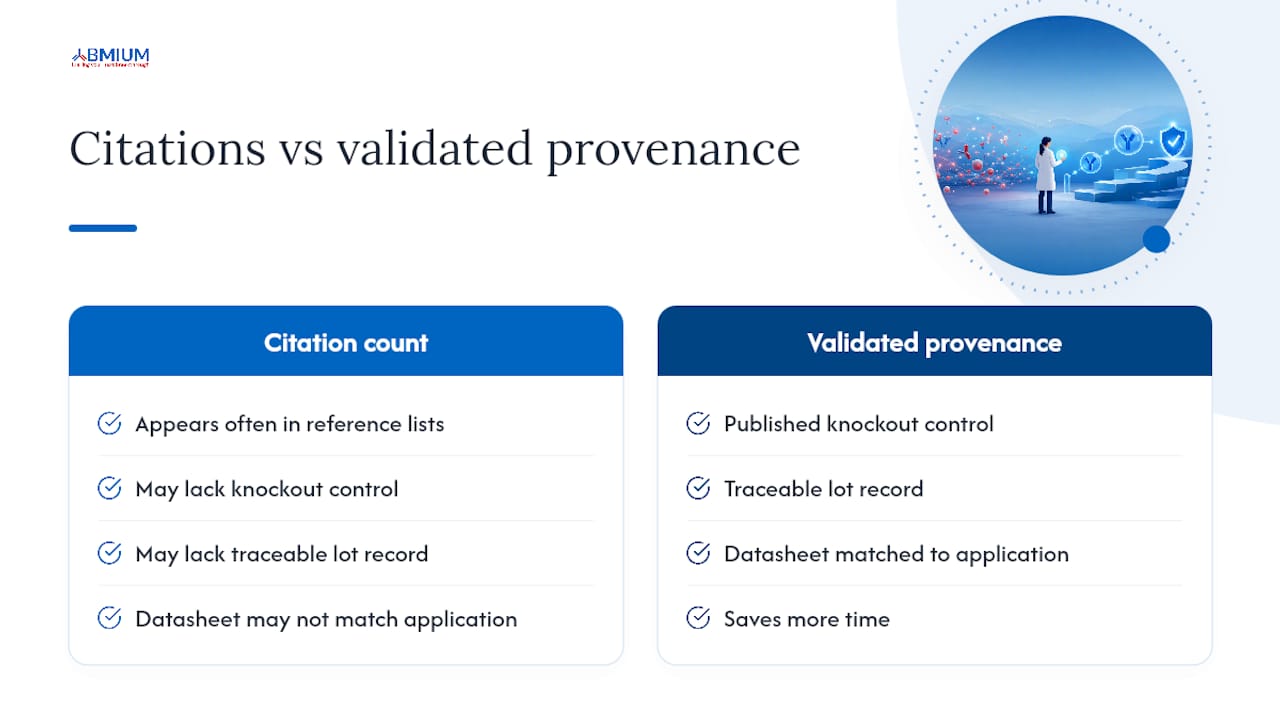
Chasing citation count as a proxy for quality is a habit worth breaking. A reagent with fewer citations but a published knockout control, a traceable lot record, and a datasheet matched to your exact application will save more time than one that simply appears more often in reference lists. That is the lesson buried in most retraction stories involving mislabelled antibodies: the failure was rarely visible until someone actually checked the provenance.
Get pre-purchase validation support from ABMIUM
ABMIUM gives you something most catalogue suppliers do not: the ability to query lot provenance and validation evidence before you commit spend, rather than discovering a reagent’s limitations after a failed experiment. Where other suppliers hand you a static datasheet and a purchase button, ABMIUM’s verified antibody catalogue lets you request additional validation detail, ask about recombinant conversion for a specific clone, or get a quote for custom antibody development tailored to your target.
If you are choosing between formats for a critical experiment, start with a product like the Anti-Rat IgG secondary antibody, where lot information and application notes are laid out in full. Request pre-purchase validation or a custom quote directly through ABMIUM’s catalogue before your next order goes in.
Sources
- GBSI press release: survey on antibody usage and validation practices
- PubMed: study on antibody validation and reproducibility
- Nature commentary on reproducibility and transparency (DOI)
- Custom antibody suppliers - CiteAb
- UKRN case study: supporting improvements to biomedical research using antibodies
FAQ
Which companies are known for selling antibodies?
The market includes large multi-brand marketplaces, specialist recombinant manufacturers, and providers like ABMIUM that focus specifically on validated, traceable catalogues with pre-purchase support.
How much does it cost to develop a custom antibody?
Costs vary depending on target complexity, host species, and whether recombinant conversion is included, so request a scoped quote directly from a provider rather than relying on a generic published figure.
What are the top-selling monoclonal antibodies?
Citation-based datasets such as CiteAb’s most-cited antibody data show sales and citations concentrate around a small number of long-established clones, though high citation counts do not guarantee superior validation.
Where can I buy antibodies?
You can buy directly from a specialist online catalogue such as ABMIUM, from large aggregator marketplaces, or through institutional purchasing agreements, provided the source publishes lot-level validation evidence.